

Contents
In brief
- Where: Kalisz, in Greater Poland, one of the country’s oldest cities.
- Acquisition: February 2026, for 4.1 million zlotys.
- Programme: 30 to 40 premium rooms and suites.
- Signature: a 1914 Neo-Baroque facade designed by Hugon Kuder, a period lift and a two-level bank vault.
The rehabilitation of banking heritage is emerging as one of the most fertile avenues of contemporary hospitality. In Kalisz, one of Poland’s oldest cities, a monument left vacant for years is preparing to be reborn in a far more hospitable guise. In February 2026, a local entrepreneur purchased the former Kalisz headquarters of the Bank Handlowy of Warsaw at 29 Śródmiejska Street for 4.1 million zlotys. The building, whose condition had deteriorated to the point of alerting building control services, is set to become the most upscale hotel address in the region.
An architectural gem designed by Hugon Kuder

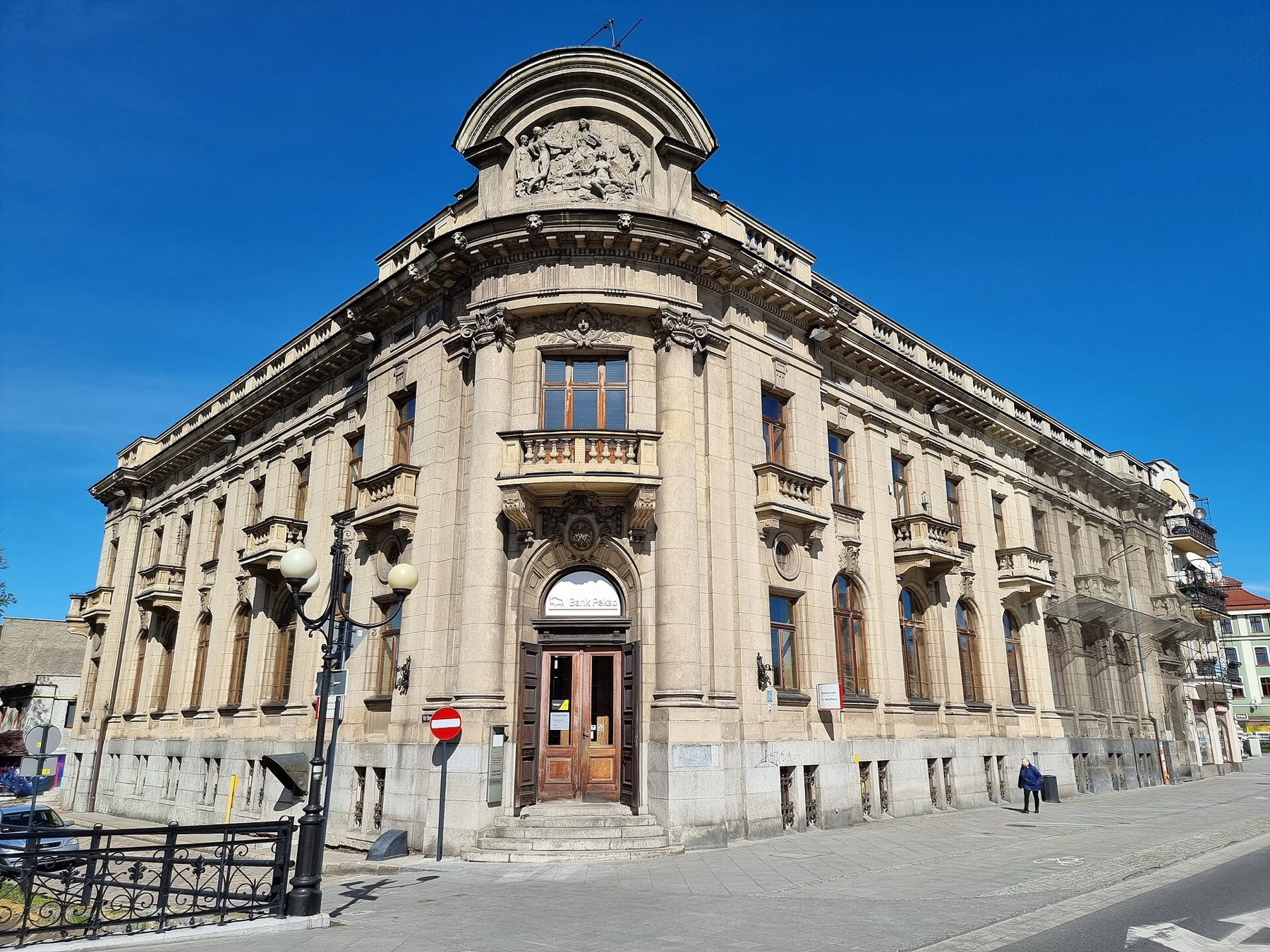
Erected in 1914, the building bears witness to the prosperity of Kalisz on the eve of the First World War. It housed the local branch of the Bank Handlowy of Warsaw and bears, engraved in the sandstone of its elevation, the plaque attesting to its authorship. Its creator, Hugon Kuder (1866-1931), a graduate of the Berlin Polytechnic, is among the most significant architects of the Polish lands at the turn of the 20th century. True to historicist forms, he gave this commission a Neo-Baroque scale and a resolutely metropolitan character.
The ornamentation of the facade, its sculpted reliefs and sophisticated structural details make it one of the strongest visual signatures of the city centre. Spread over four levels and more than a thousand square metres, the spaces were distinguished at the time by a rare technical modernity. The interiors retain original engineering elements, including an old lift set to be restored and reintegrated into the guest experience.
Kuder’s Berlin training is reflected in the robustness of the structure, designed to last as well as to project the image of stability demanded by major financial institutions. Massive columns, carved cornices and mascarons make up a decorative vocabulary that remains instantly legible more than a century later.
Details of a saving transaction
The future of the building was decided in early 2026. A businessman from Kalisz, head of several local companies including a petrol station on Wrocławska Street, acquired it for 4.1 million zlotys. The sale ends a long period of uncertainty, during which the bank Pekao SA had unsuccessfully sought to sell a heritage property whose condition was deteriorating.
The situation had become worrying to the point that falling plaster threatened the public highway. Building control services issued a works injunction to secure the structure. The acquisition therefore comes at a pivotal moment, allowing the monument to be saved while assigning it a use capable of financing its maintenance.
The rehabilitation will require ongoing dialogue with the voivodeship’s heritage conservators. The work must respect the load-bearing structure and the protected facades, and its cost will far exceed the purchase price, if only to bring a building from the beginning of the last century up to safety, thermal and acoustic insulation standards.
A luxury metamorphosis

The programme unveiled by the new owner aims for the pinnacle of regional hospitality. It plans for 30 to 40 premium rooms and suites, tailored for an international clientele accustomed to the standards of the finest boutique hotels. The generous ceiling heights and large openings lend themselves well to this residential use.
In addition to accommodation, there will be dining lounges, reception areas and conference rooms. But the project’s most unique asset lies underground: the building houses a two-level basement occupied by a vast bank vault, a relic of its original activity. Thick walls, armoured doors, a strongroom atmosphere: the space calls for a unique use, such as a speakeasy bar, private club or wellness area, though the owner has not yet made a decision.
Air conditioning, contemporary bathrooms and home automation will present an engineering challenge within a protected shell. The central staircase should be preserved and serve as the backbone for circulation. The contrast between original materials and noble finishes outlines the aesthetic signature expected of this type of conversion.
A strategic location on the banks of the Prosna
Beyond its own qualities, the establishment will enjoy a prime location. It stands in the heart of Śródmieście, at the entrance to the historic pedestrian zone, along a branch of the Prosna. This proximity to the water opens up the possibility of restaurant terraces on the river, a rare privilege in the city.
For the municipality, a hotel of this calibre represents a lever for attractiveness: it captures business and leisure clientele with high purchasing power and revitalises the shopping thoroughfare of Śródmiejska Street. Kalisz, often presented as Poland’s oldest city, has a heritage that remains largely untapped in the high-end segment, and the proximity of parks and theatres reinforces the appeal of the address for a cultural stay.
Our view
The transformation of the former bank in Kalisz says something about the maturity of the Polish hotel market outside the usual metropolises of Warsaw, Kraków or Gdańsk. By committing 4.1 million zlotys to a building steeped in history, the buyer is betting on niche luxury and heritage authenticity. Today’s discerning traveller seeks addresses with a narrative, where architecture precedes decoration. The challenge will be to reconcile conservation requirements with the comfort demanded by this standard, but the original vault and lift offer a narrative material that few new projects in Central Europe can claim.