

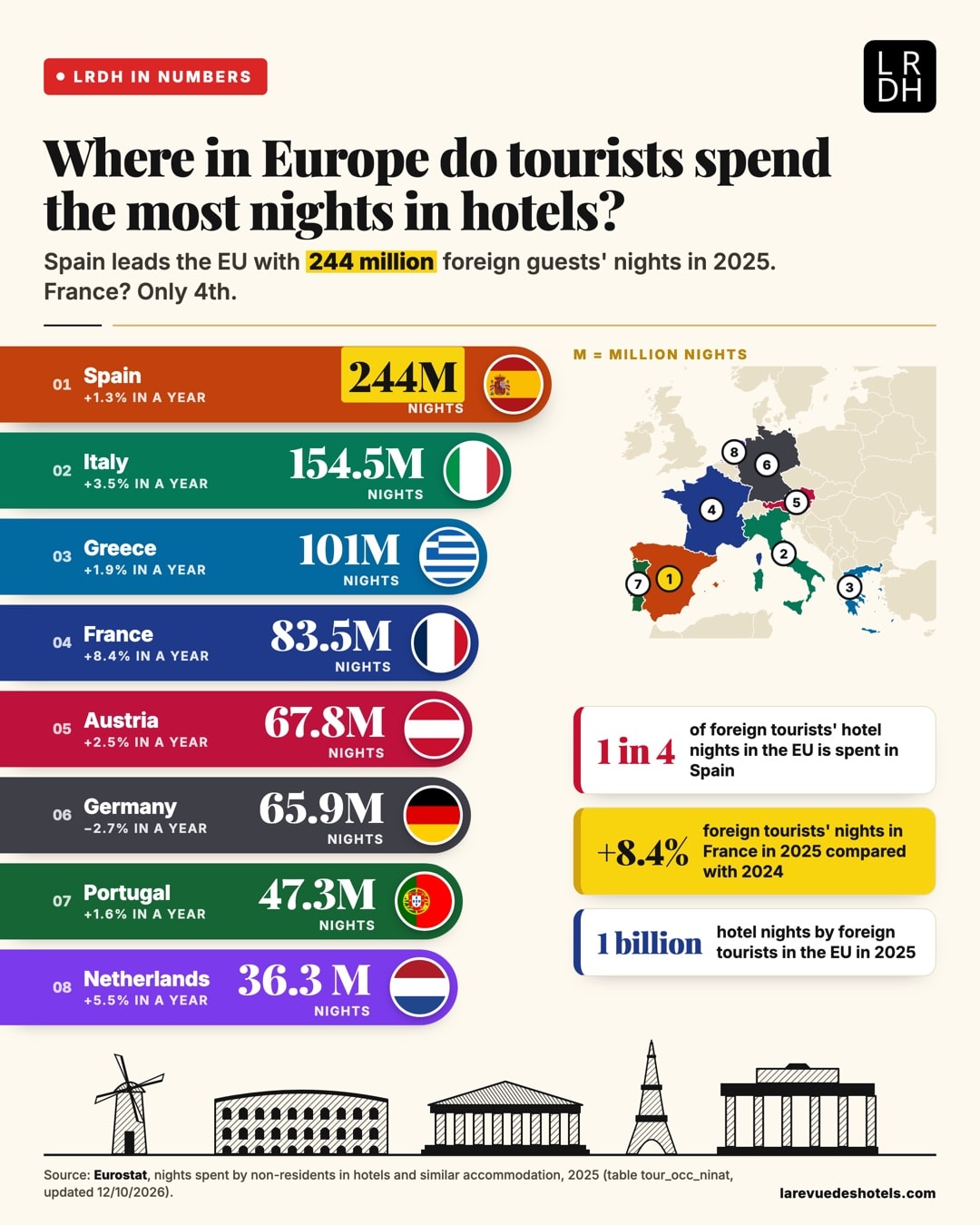
For the first time, foreign tourists spent more than a billion nights in European Union hotels in 2025: 1,001 million to be precise, according to Eurostat, compared with 944.5 million in 2019, before the pandemic. Spain hosts one in four of them, while France, often described as the most visited country in the world, comes only fourth.
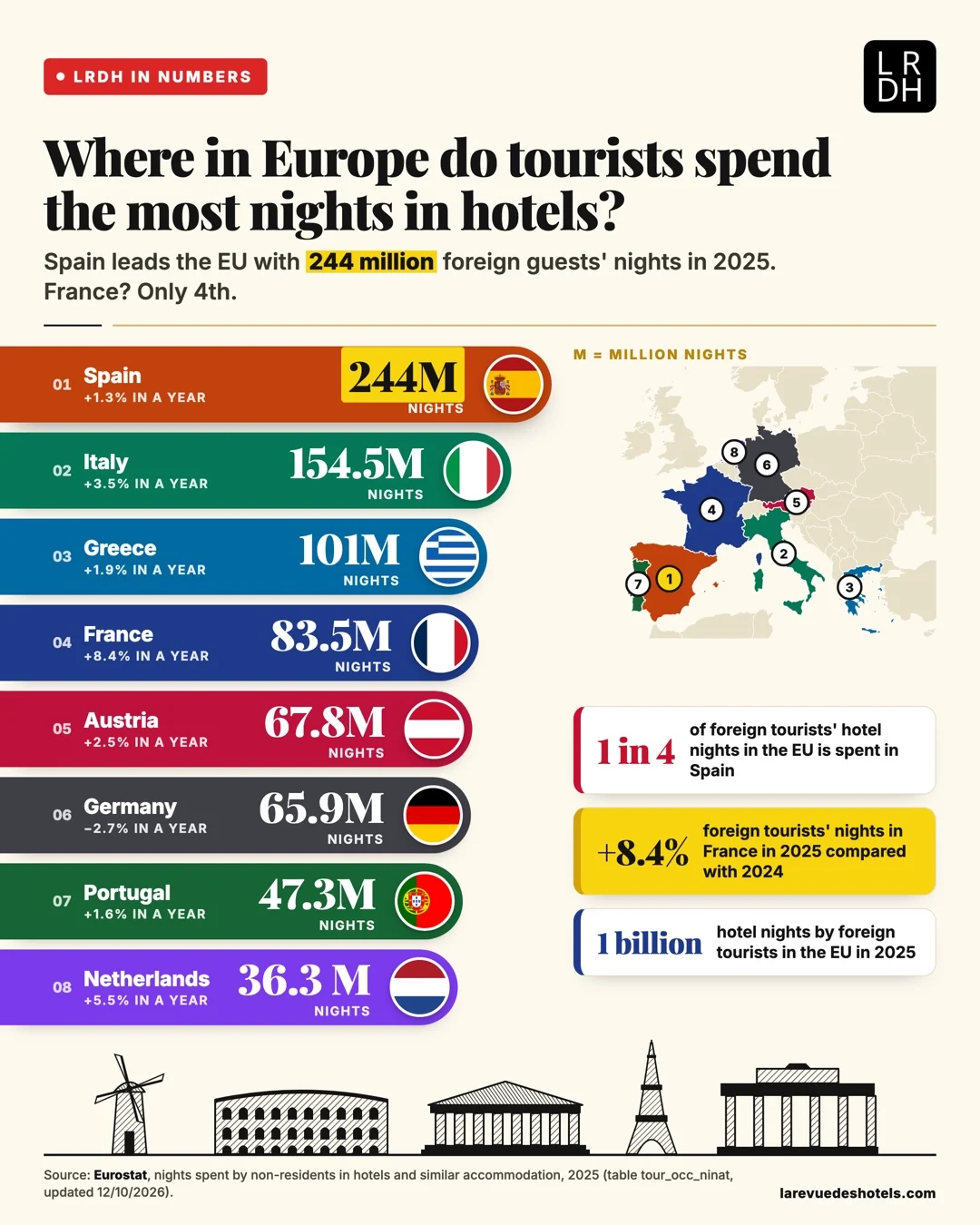
- 🇪🇸 Number one · Spain, with 244.2 million hotel nights by foreign tourists in 2025, one in four in the EU
- 🥈 The podium · Italy (154.5 million) and Greece (100.9 million) complete the top three
- 🇫🇷 France · fourth with 83.5 million, but the strongest growth in the top eight: +8.4% in a year, a record
- 🏨 The French paradox · foreigners account for only 38% of hotel nights in France, against 67% in Spain
- 📉 The only decline · Germany, at 65.9 million (−2.7%), still almost 10% below its 2019 level
- 📊 The source · Eurostat, nights spent by non-residents in hotels, 2025 data updated on 12 October 2026
LRDH in numbers
Where foreign tourists spend the most hotel nights
Nights spent by non-residents in hotels, in millions, 2025 · European Union · Eurostat
Source: Eurostat, table tour_occ_ninat (hotels and similar accommodation), updated on 12/10/2026. How to read: in Spain, 67% of hotel nights are spent by tourists from abroad.
Contents
Spain takes one in four foreign hotel nights
With 244.2 million nights spent by foreign tourists in its hotels, Spain accounts for 24% of the entire European Union. It grew by a further 1.3% over the year and stands 9% above its 2019 level.
Above all, the figure reveals the country’s reliance on international tourism: two in three hotel nights there are spent by visitors from abroad (366 million nights in total). That strength draws investors, as shown by the 2.46 billion invested in Spanish hotels in the first half of 2026.
Italy and Greece complete the podium
Italy records 154.5 million nights by foreigners (+3.5% year on year), just over half of the country’s hotel nights: Italian tourism also continues to rely on its domestic clientele.
Greece, third with 100.9 million nights, is by contrast the most internationally oriented country in the top eight: 85% of its hotel nights are spent by visitors from elsewhere.
Why France ranks only fourth
With 83.5 million nights by foreigners, France nonetheless posts its best ever score: +8.4% year on year, the strongest rise in the ranking, and a level above its previous peak of 2018 (82.2 million).
The gap with Spain is explained first by the weight of French domestic guests: of 220 million hotel nights in France in 2025, foreigners account for only 38%. Another factor: some visitors stay outside hotels, in holiday rentals or on campsites, types of accommodation this table does not count. Rental platforms, for their part, recorded 144 million nights in Europe in the first quarter of 2026.
For a breakdown of the season in France, by market and by destination, read our analysis of summer 2026.

Germany, the only country in decline
Germany slipped by 2.7% to 65.9 million nights and remains almost 10% below its 2019 level (72.8 million). As in France, its hotel sector relies mainly on its own residents: foreigners account for only 22% of its hotel nights, the lowest share in the top eight.
Austria, Portugal and the Netherlands follow
Austria, fifth with 67.8 million nights (+2.5%), draws 72% of its hotel nights from foreign tourists but remains slightly below its 2019 level.
Portugal (47.3 million, +1.6%) and the Netherlands (36.3 million, +5.5%) are among the countries that have grown most since 2019: +12.5% for Portugal, +20.4% for the Netherlands, the strongest rise in the ranking over six years.
The full top ten ranking
Nights spent by foreign tourists in hotels and similar accommodation, in millions. The last column shows the share of foreigners in all of the country’s hotel nights.
| Country | 2025 | 2024 | Year on year | Since 2019 | Foreign share |
|---|---|---|---|---|---|
| 1. 🇪🇸 Spain | 244.2m | 241.0m | +1.3% | +9.3% | 67% |
| 2. 🇮🇹 Italy | 154.5m | 149.2m | +3.5% | +9.9% | 54% |
| 3. 🇬🇷 Greece | 100.9m | 99.0m | +1.9% | +9.2% | 85% |
| 4. 🇫🇷 France | 83.5m | 77.0m | +8.4% | +8.3% | 38% |
| 5. 🇦🇹 Austria | 67.8m | 66.2m | +2.5% | −2.2% | 72% |
| 6. 🇩🇪 Germany | 65.9m | 67.7m | −2.7% | −9.6% | 22% |
| 7. 🇵🇹 Portugal | 47.3m | 46.5m | +1.6% | +12.5% | 70% |
| 8. 🇳🇱 Netherlands | 36.3m | 34.4m | +5.5% | +20.4% | 55% |
| 9. 🇨🇿 Czechia | 24.1m | 23.0m | +4.6% | −1.5% | 53% |
| 10. 🇭🇷 Croatia | 22.2m | 21.8m | +1.7% | −4.3% | 84% |
| European Union (27) | 1,001.4m | 972.9m | +2.9% | +6.0% | 52% |
What these figures measure
Eurostat counts nights spent by non-residents, meaning travellers who live outside the country, whatever their nationality, in hotels and similar accommodation. Private rentals, campsites and second homes are not included.
The 2025 data were updated on 12 October 2026 and cover only the 27 countries of the European Union. The Eurostat table gives the breakdown by country and by year.