


After the OMO5 Kyoto Gion and the OMO7 Osaka, we pushed aside the red noren of Hoshino resorts KAI Kaga, at Yamashiro Onsen, in Ishikawa prefecture. Forty-eight rooms, three baths, a kaiseki dinner served on Kutani porcelain and a lion dance performed every evening by the staff: here is our full review, and our score.
- Where: Yamashiro Onsen, in Kaga (Ishikawa prefecture), about ten minutes by car from Kagaonsen station
- The property: 48 signature rooms dressed in papers and dyed textiles from the region
- The bath: three thermal spaces inside the hotel, plus free access to the Ko-Sōyu, the historic public bathhouse right across the street
- The history: a ryokan founded in 1624, whose main building and tea pavilion are registered cultural properties
- The exclusive: the first hot spring ryokan in Japan with its own kintsugi workshop, the art of repairing ceramics with gold
- In the evening: a shishi lion dance performed by the staff, every night
- Our score: 9.7/10
Contents
- A ryokan that begins with a red curtain
- Before KAI Kaga: the Shiroganeya, a ryokan since 1624
- A garden at the centre, and a bench to sit on
- Rooms designed like craftsmen’s workshops
- The baths: the hotel’s own, and the treasure across the street
- A table that tells Ishikawa, plate by plate
- The hotel’s show: the lion dance
- The kintsugi workshop, a first in Japan
- The Bengara Lounge, where you choose your own cup
- What the hotel adds, and what is included
- What to know before booking
- Our verdict
A ryokan that begins with a red curtain
It all starts with the noren, that deep red fabric curtain stamped with the plum blossom crest of the Kaga domain, which you push aside by hand to enter. Behind it, a stone path crosses a garden before reaching the house. That threshold sets the tone: the hotel was designed to be walked slowly, at the scale of the hot spring town around it. The dark timber and pale render buildings are arranged around a checkerboard courtyard, and check-in happens sitting down, tea in front of you, with no reception desk.
◆ In pictures · Arriving at the hotel
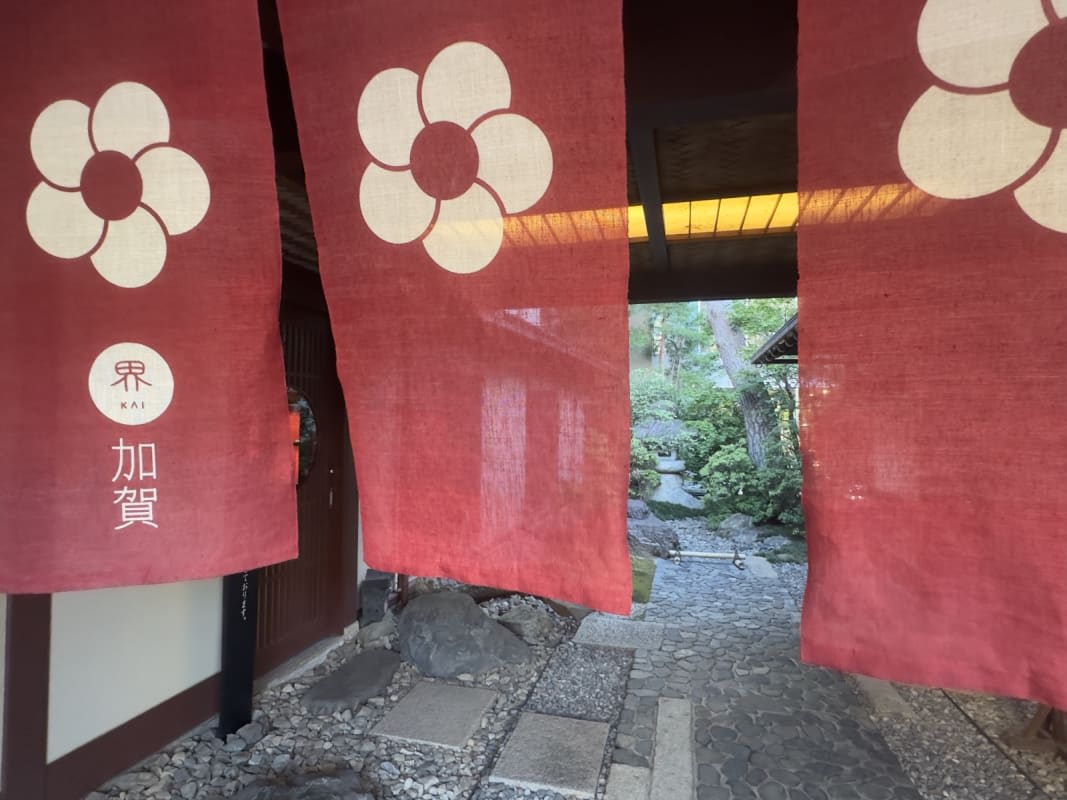
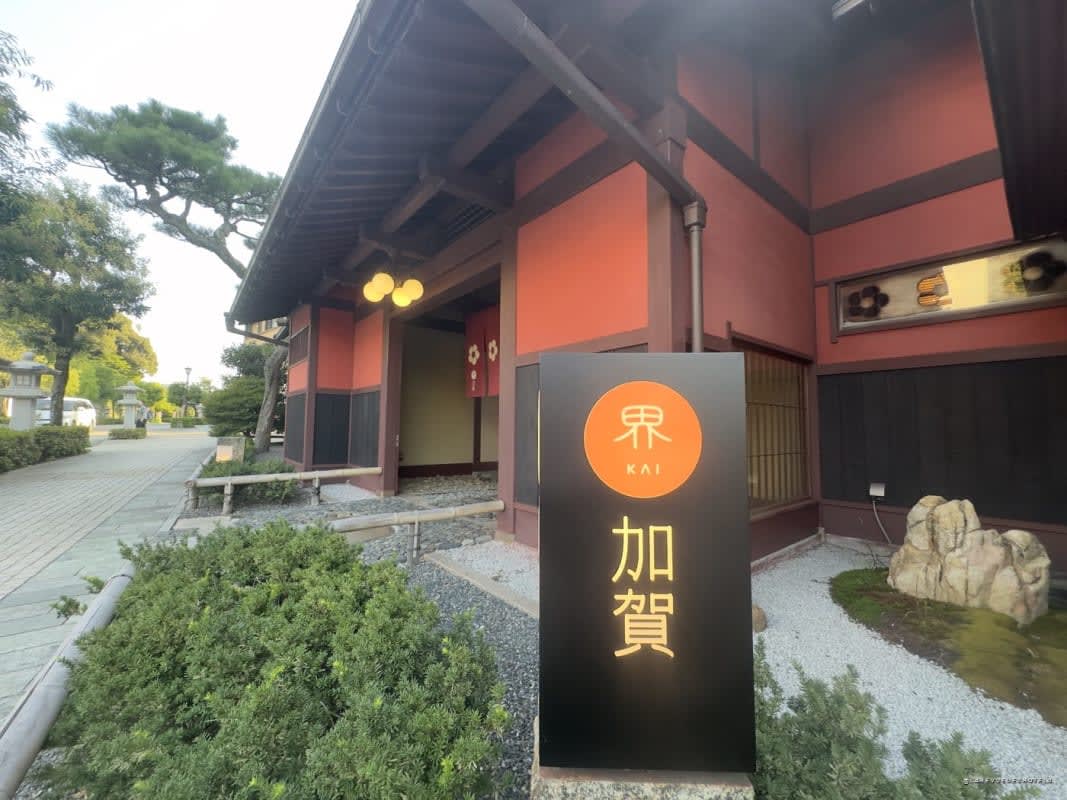
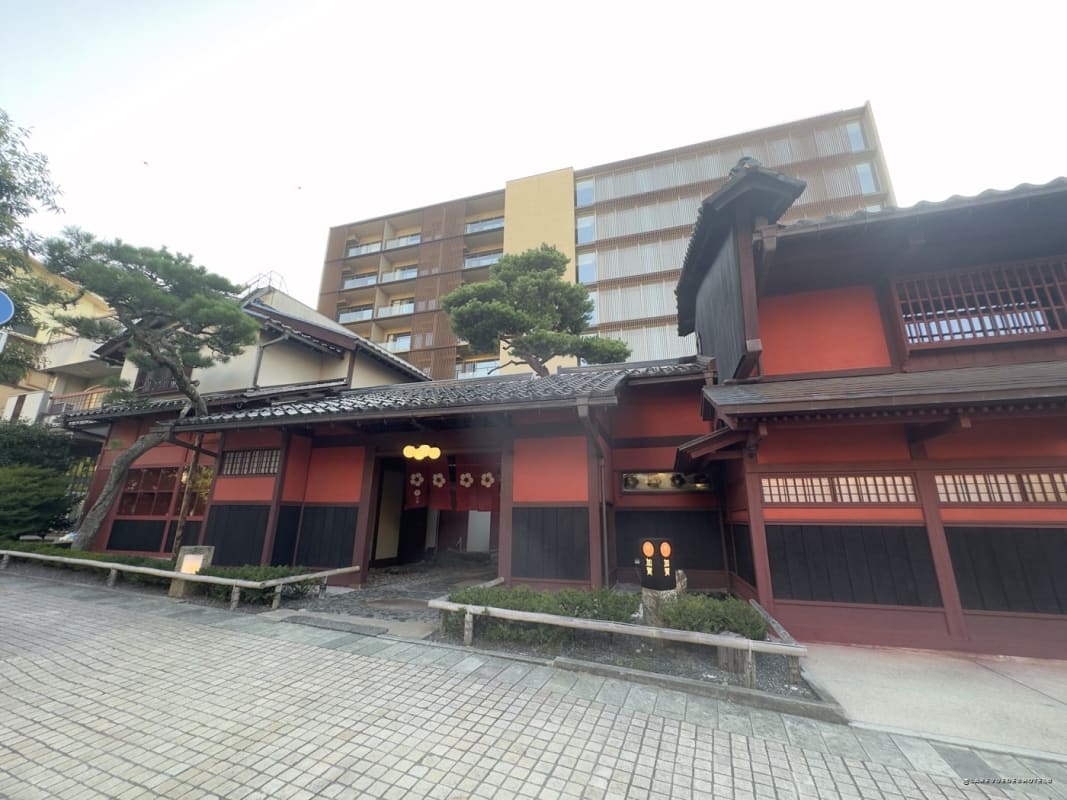
◂ Swipe · tap a photo to enlarge ▸
Before KAI Kaga: the Shiroganeya, a ryokan since 1624
The building was not put up for Hoshino Resorts, and you can feel it as soon as you walk in. The address was called the Shiroganeya (白銀屋), a ryokan founded in 1624, at the start of the Edo period, and long the only one in Yamashiro Onsen to have kept the look of that era. Two parts are now listed among Japan’s registered tangible cultural properties: the main building, a two-storey timber structure dated to the Bunsei era, between 1818 and 1830, and the tea pavilion, from the Meiji period.
Hoshino Resorts took the house over and reopened it under the KAI name on 1 October 2012, the brand’s seventh address. A restoration campaign followed in 2014 and 2015, carried out by carpenters used to heritage sites: the timber frame was dismantled piece by piece, posts and beams taken down, reworked one by one, then put back up. Behind the historic building, a new eight-storey guest wing was raised, aligned with the codes of the district. That is where you sleep, while the listed parts house the public spaces.
Then there is the name that explains everything else. Kitaōji Rosanjin, ceramicist and gourmet, was a regular at the Shiroganeya, and a room category still bears his name. He is credited with a saying that remains famous in Japan, that tableware is the kimono of food. Seen that way, the house is not using ceramics as decoration: it is applying to the letter the legacy of a guest who passed through a century ago, from the kintsugi to the Kutani laid out at every course.
A garden at the centre, and a bench to sit on
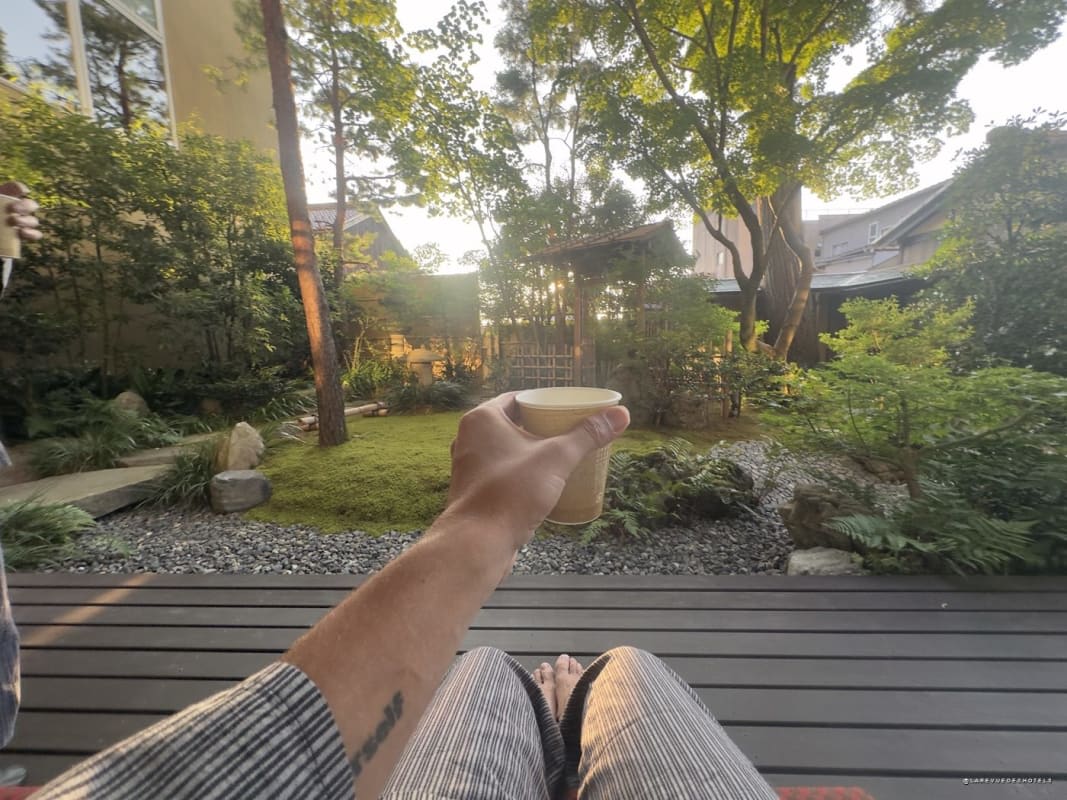
The garden is not a backdrop set off to one side: it occupies the heart of the house, and the public areas are glazed so that you keep it in view at all times. On the courtyard side, a polished stone terrace draws a vast checkerboard of black, white and coloured triangles, catching the late afternoon light and reflecting the tiled roofs. A pruned pine, a few placed rocks, some low lanterns: nothing exuberant, it is all a matter of proportion.
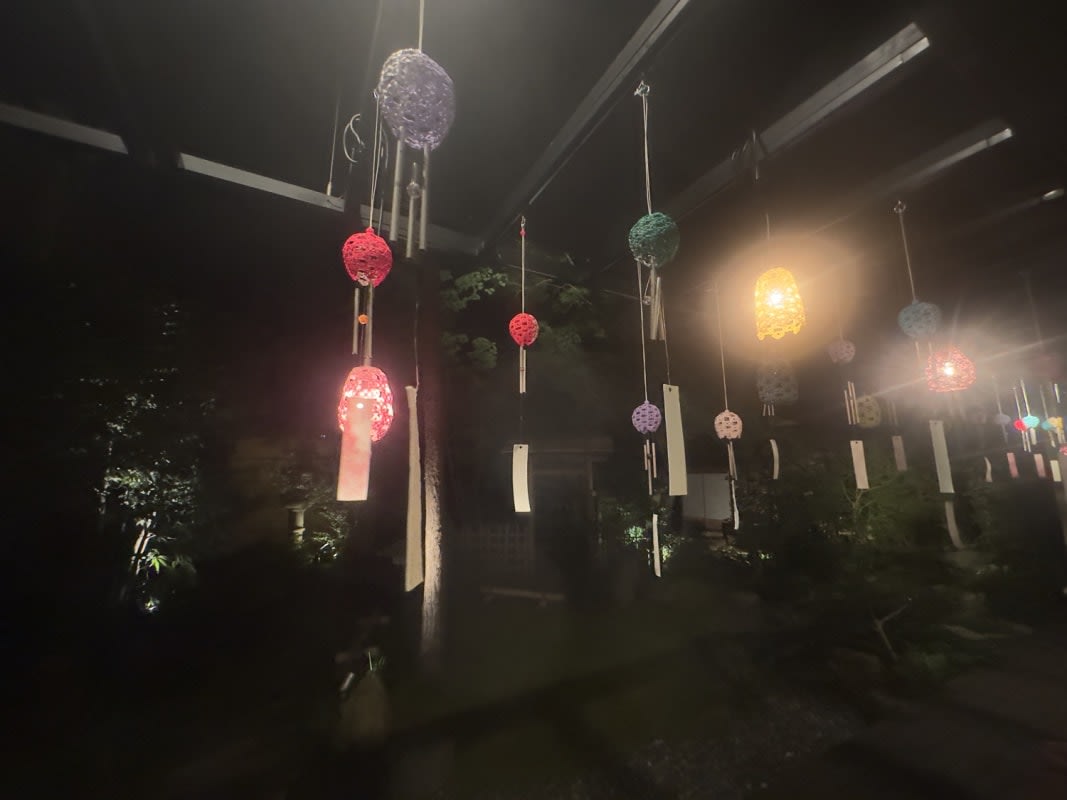
On the other side, the planted section takes over: a carpet of moss, ferns, maples, pines, raked gravel and a small latticed wooden shelter. A long wooden bench runs along the garden, and that is where you settle in a yukata, drink in hand, between the bath and dinner. It is also where the house hangs its wind chimes in summer and its mizuhiki lanterns in autumn.
◆ In pictures · The garden
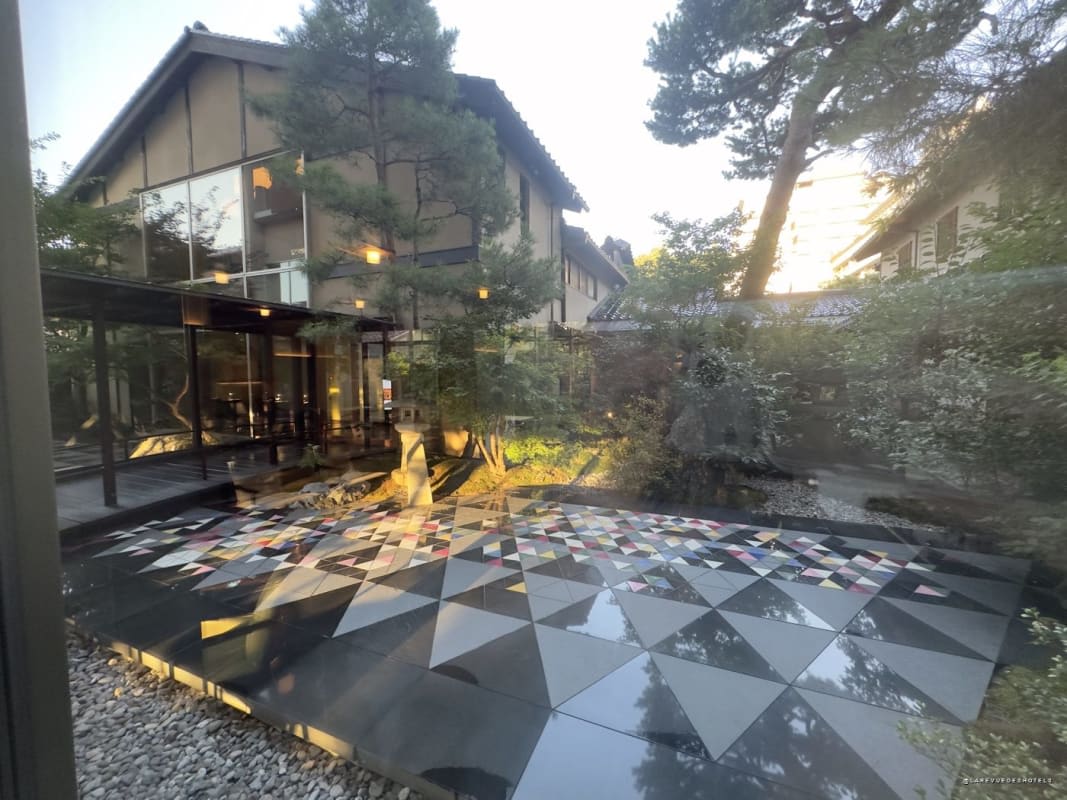
◂ Swipe · tap a photo to enlarge ▸
Rooms designed like craftsmen’s workshops
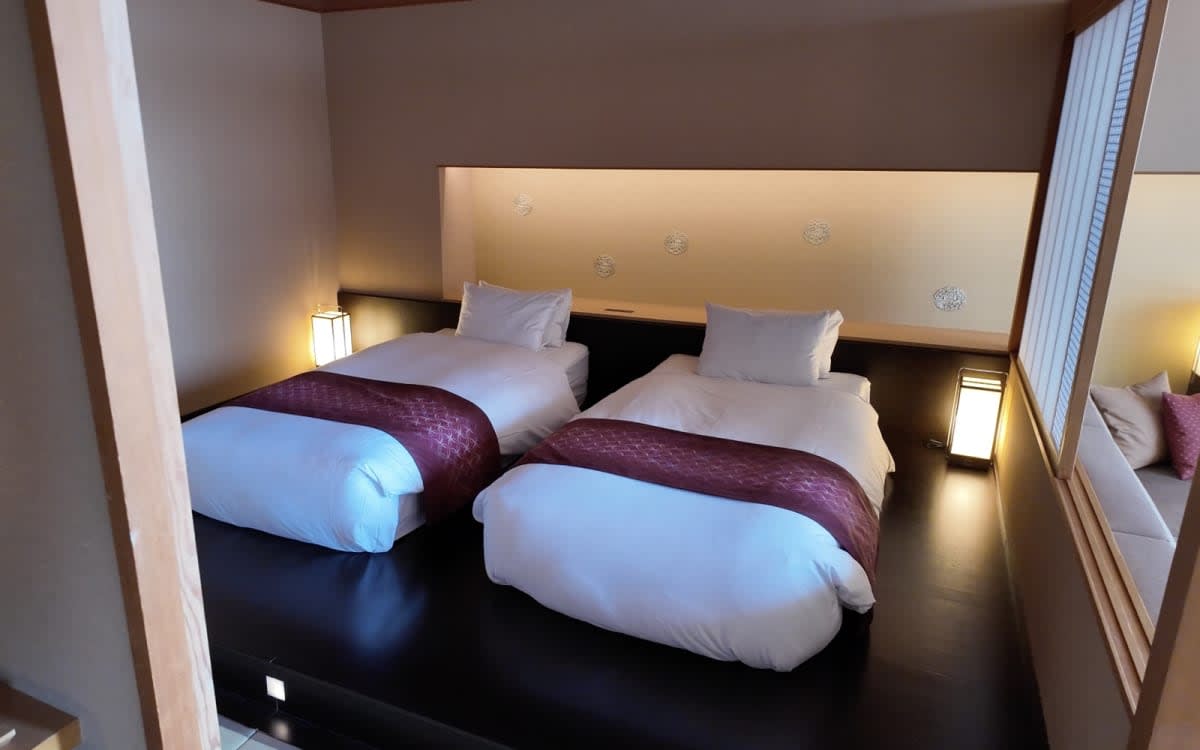
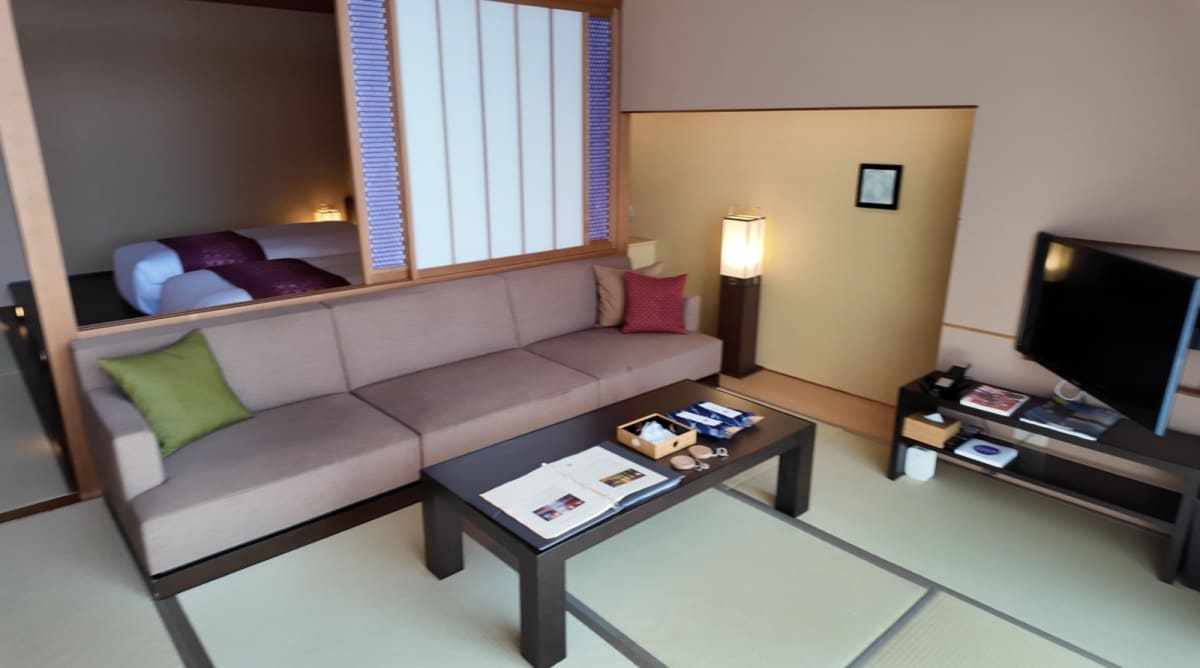
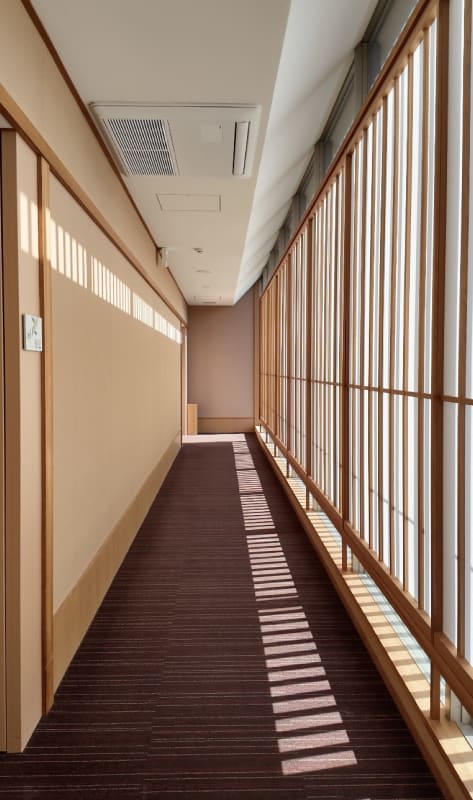
The 48 rooms carry the mark of the territory rather than that of hotel decoration. Each is organised in two parts: a tatami sitting area with a low sofa and a lacquer table, then, behind paper partitions, a dark platform where the beds rest. The headboard, stretched with pale paper, is dotted with gold leaf medallions, the region’s signature, and the bedspreads pick up a woven burgundy pattern. Washi papers, dyed textiles, Yamanaka lacquer and Kutani ceramics make up a coherent vocabulary, right down to the tea set on the sideboard.
The bathroom, contemporary and functional, opens onto a small terrace sheltered by a wooden lattice. The amenities are Japanese and presented in coloured bottles, down to the ceramic cups on the shelf. Nothing here reminds you that this is a 48-key property, and the silence, in the corridors as in the room, has a lot to do with it.
◆ In pictures · The room
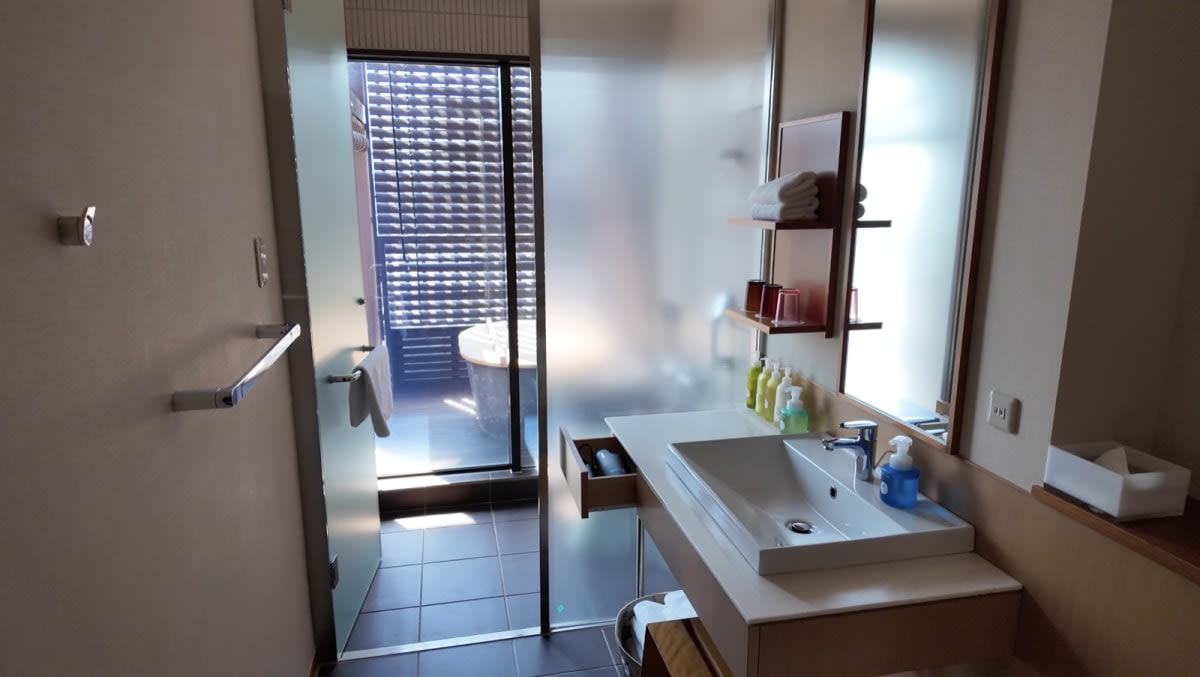
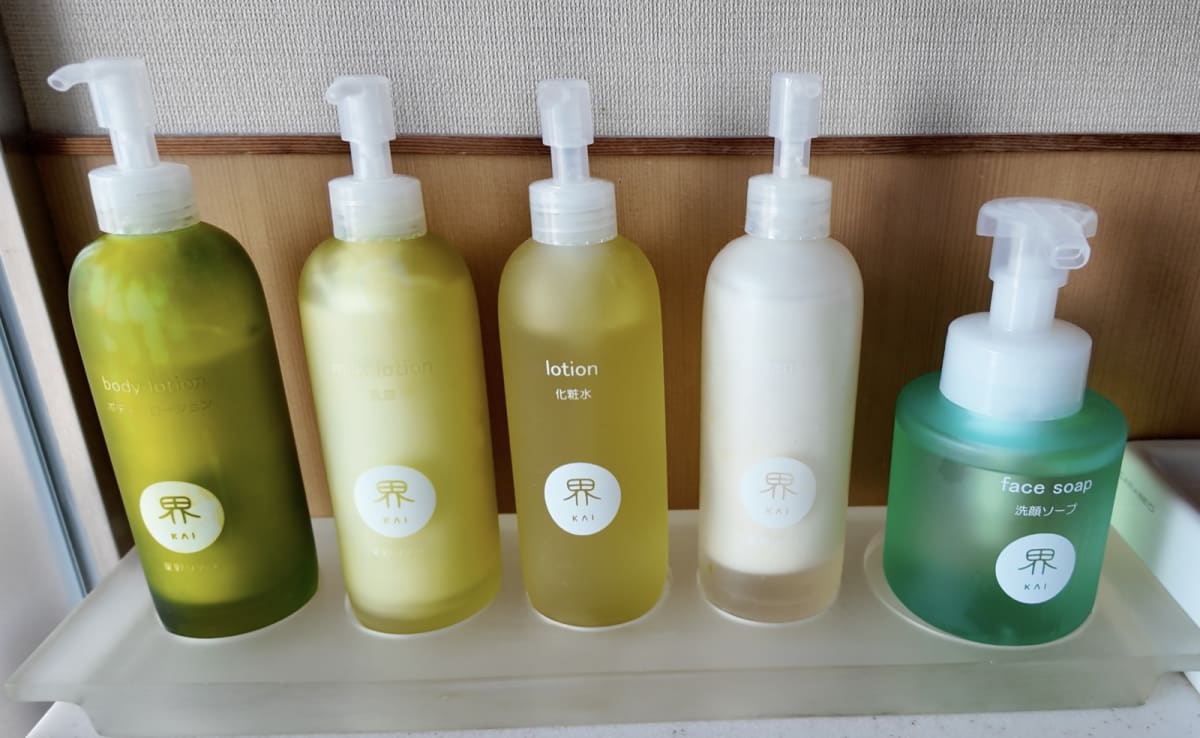
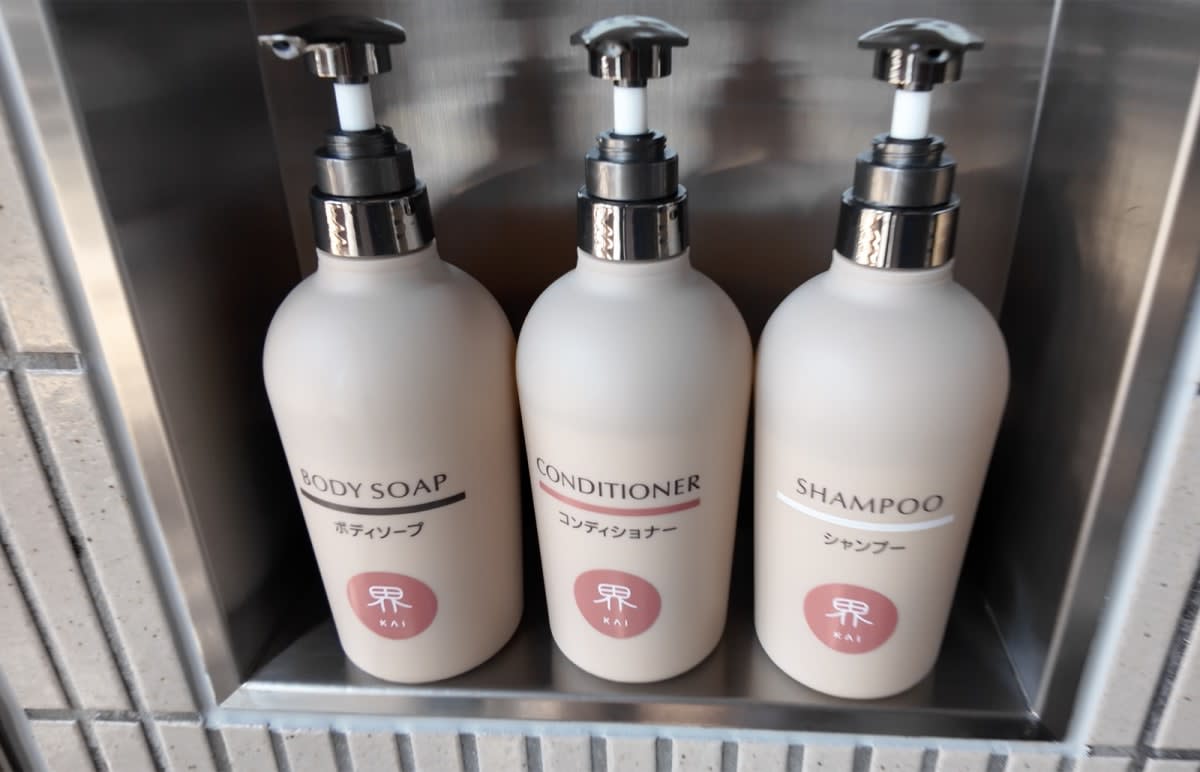
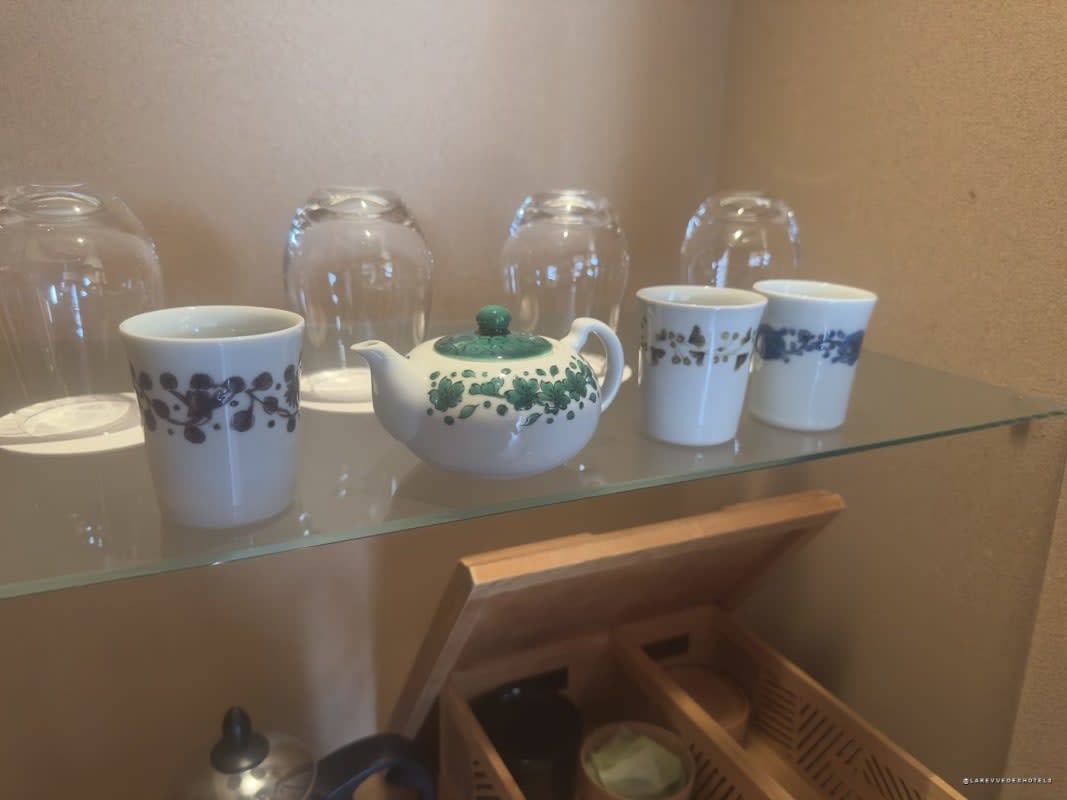
◂ Swipe · tap a photo to enlarge ▸
The baths: the hotel’s own, and the treasure across the street
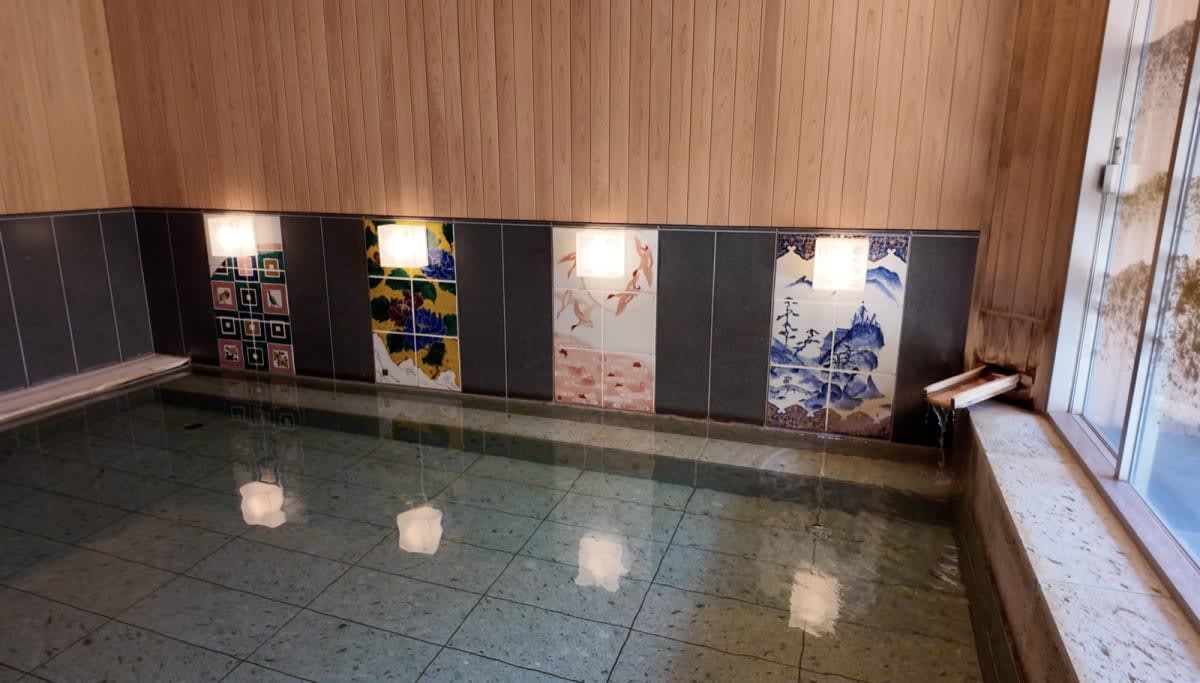
KAI Kaga draws on the Yamashiro Onsen spring, tapped for more than thirteen hundred years, and has baths of its own. The indoor pool, cut from polished green stone, runs along a timber wall punctuated by four large Kutani porcelain panels: geometric motifs, peonies on a yellow ground, red fish, a landscape in shades of blue, each backlit like a painting. A picture window runs the full length, and the scalding water arrives through a simple wooden spout. It is dense, frankly mineral, and you gladly go back before dinner and again on waking.
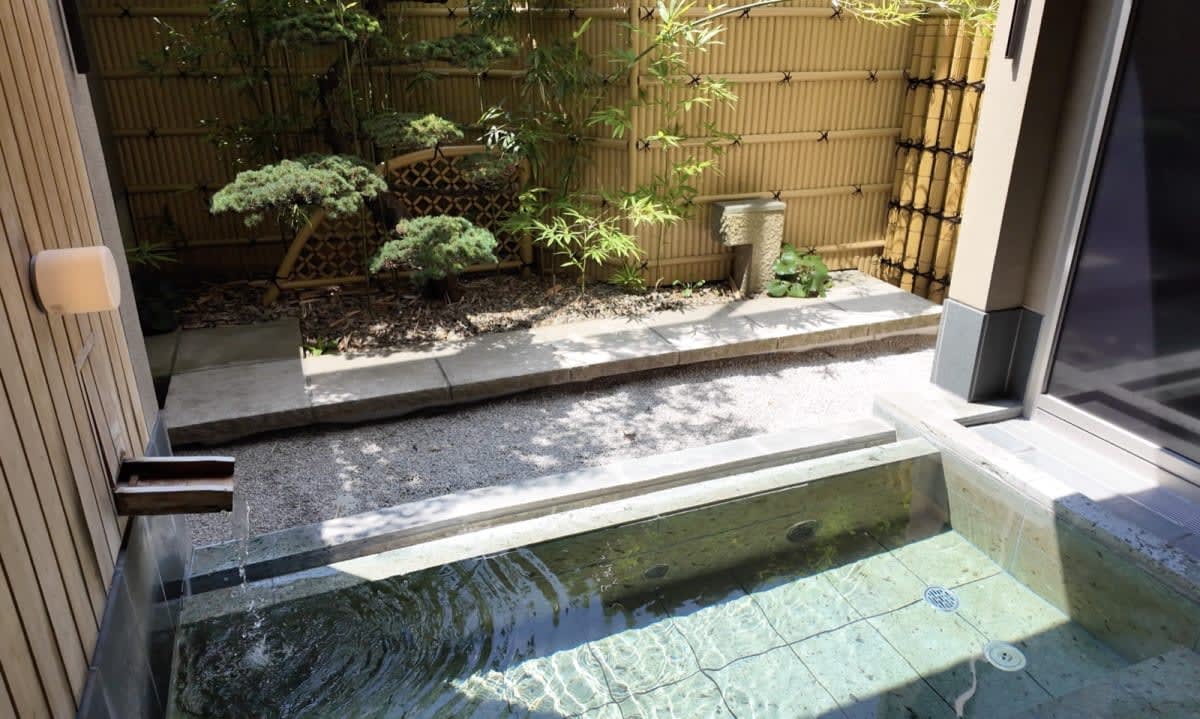
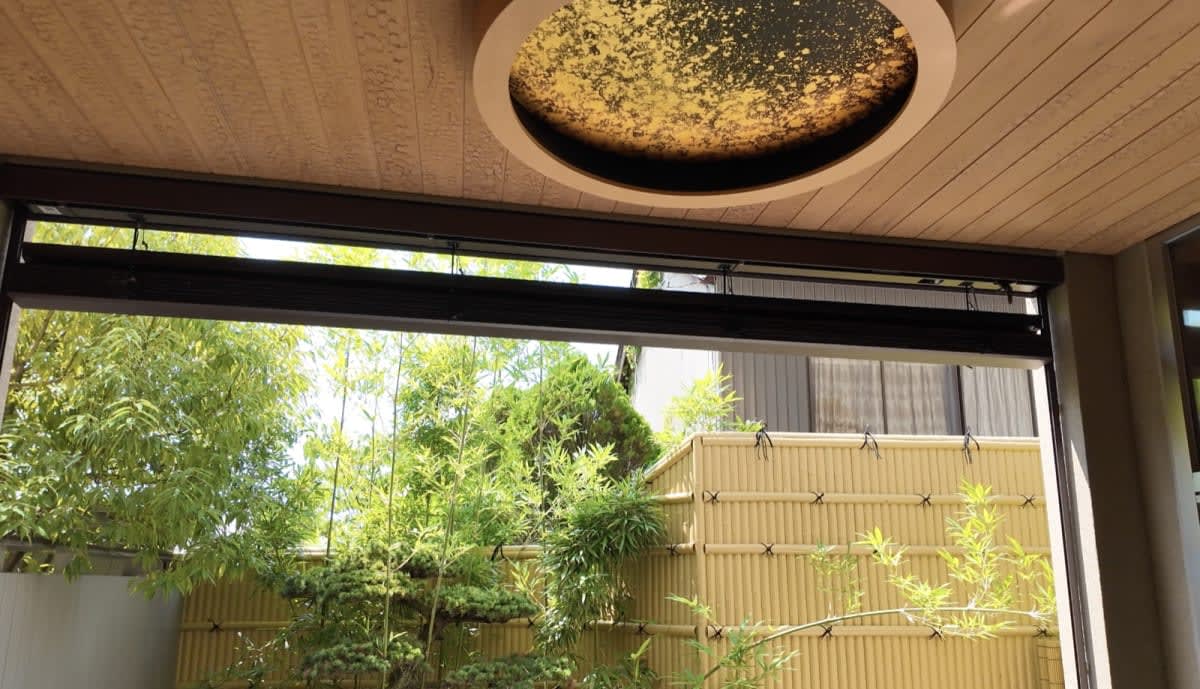
The outdoor bath is built as an extension: a low pool ringed with pale slabs, open onto a garden of bamboo, pruned pines and raked gravel, closed off by a woven bamboo fence. At night, a moon-shaped light illuminates it from the top of the wall. The changing room, plain and immaculate, completes the set, and a panel details the different bath types found across the group’s houses.
◆ In pictures · The hotel’s onsen
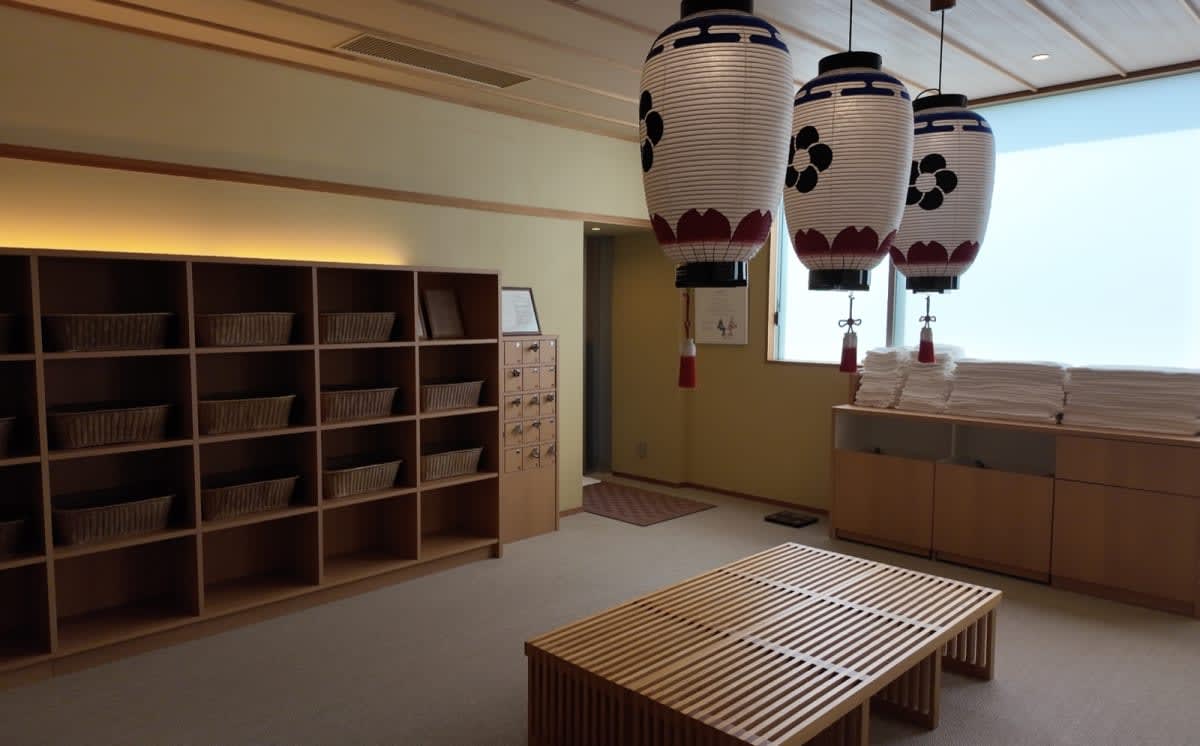

◂ Swipe · tap a photo to enlarge ▸
But the town has something better still, a few steps from the entrance: the Ko-Sōyu, a public bathhouse rebuilt in 2010 as an exact copy of the Meiji-era thermal establishment that stood there. Recognisable by its wooden facade and its black noren stamped with the three characters 古総湯, it holds cypress woodwork, brightly coloured stained glass, floor and pool edges covered in Kutani porcelain tiles, wooden buckets set down at the side: you step into it as into a period room. Entry is included in the stay, and local custom has you walk there in a yukata from your ryokan. To our eyes, it is the thermal experience not to miss at Yamashiro.
◆ In pictures · The Ko-Sōyu, Yamashiro’s public bathhouse
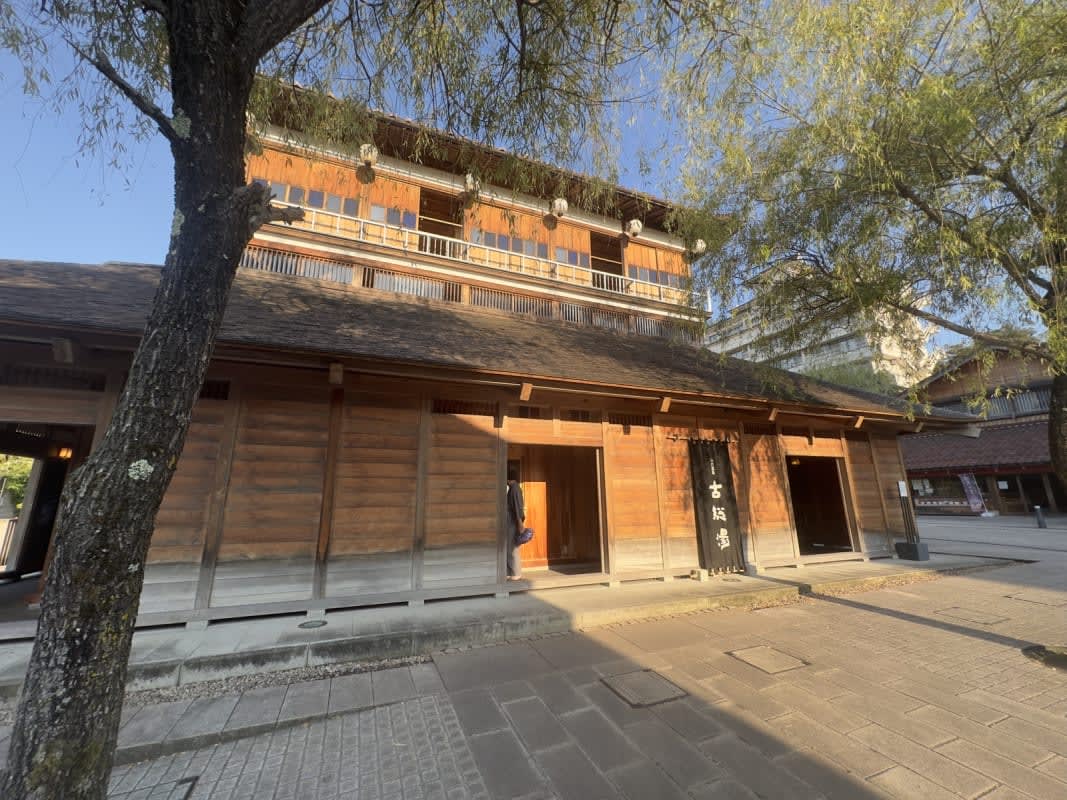
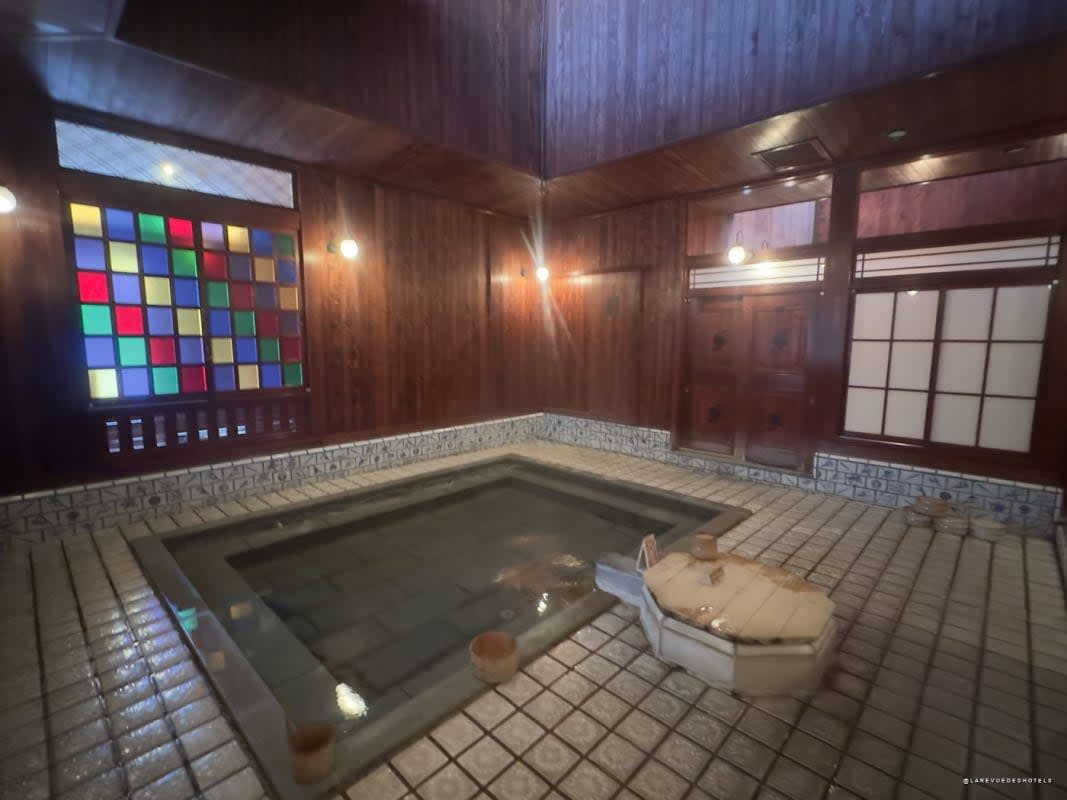
◂ Swipe · tap a photo to enlarge ▸
A table that tells Ishikawa, plate by plate
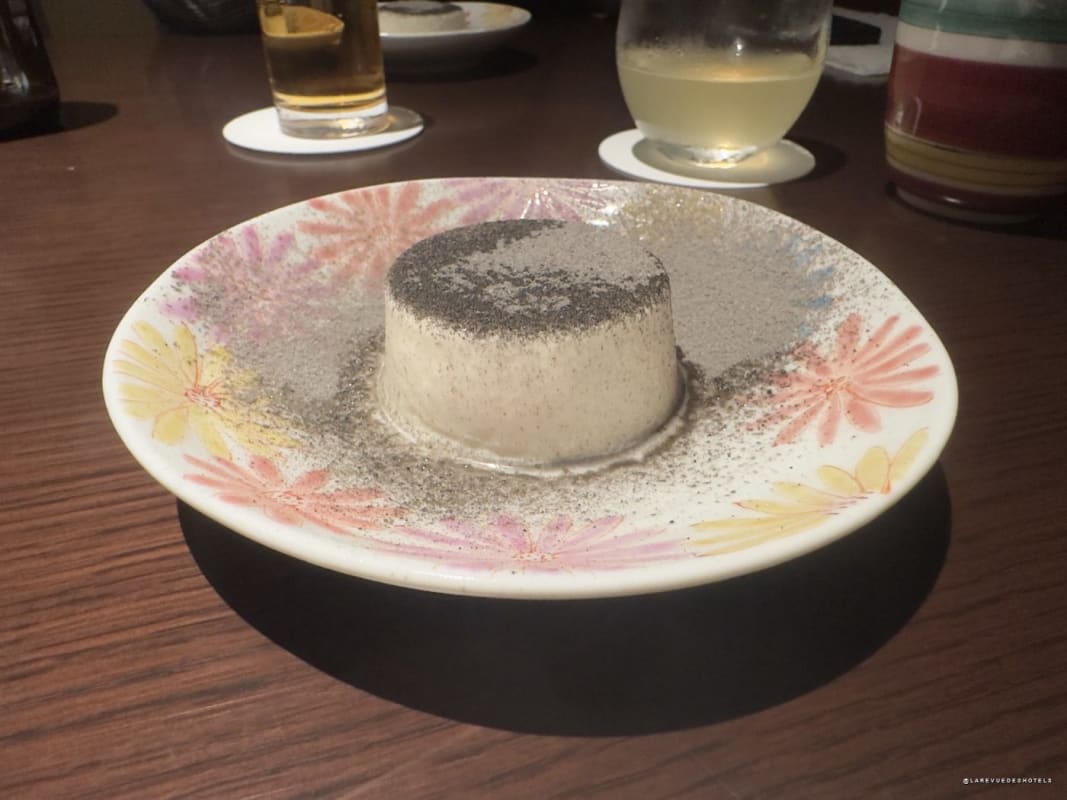
The kaiseki dinner is taken in semi-private rooms, at one of two sittings, 5.30pm or 7.30pm. The seasonal menu follows the Sea of Japan closely: steamed abalone, nodoguro, the blackthroat seaperch that the Japanese hold to be one of the archipelago’s finest fish, fugu served shabu-shabu style in a fish broth, and to finish a rice simmered with seafood.
Each dish arrives on a different piece of Kutani porcelain, part of which the hotel commissions directly from the region’s artisans: it speaks of a “marriage of dishes and cuisine”. Yamanaka lacquer for the covered bowls, brilliant ceramics for the starters: the tableware tells as much as the plate.
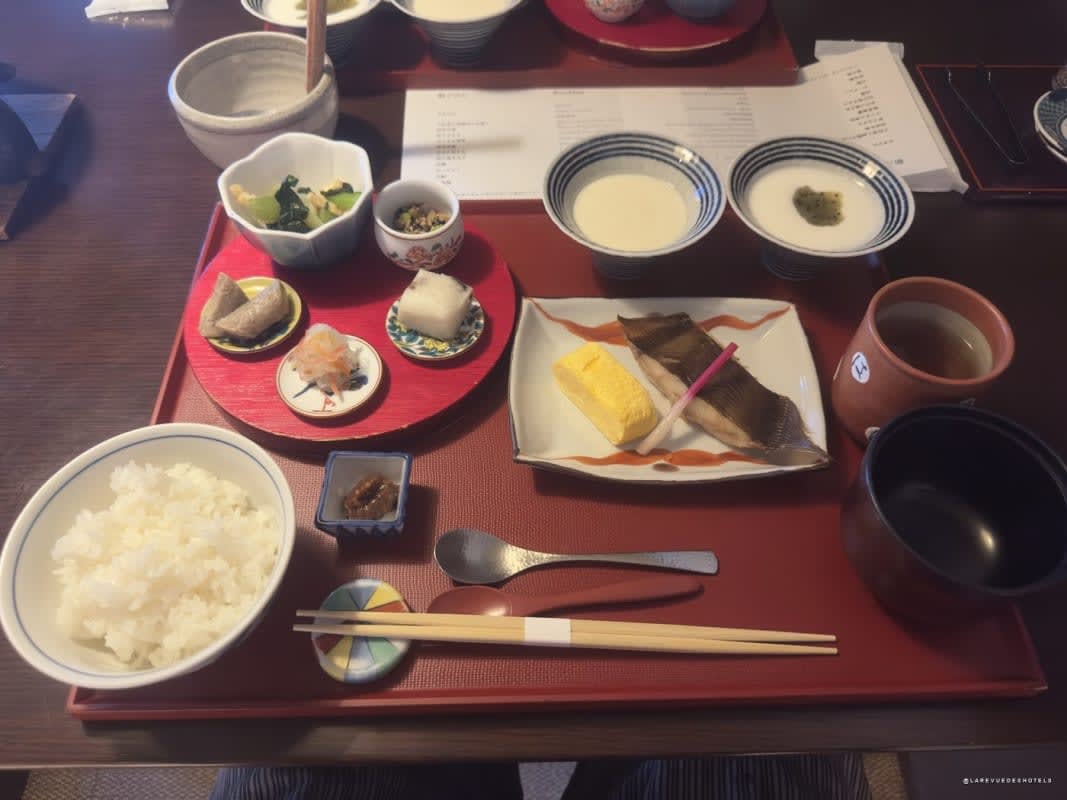
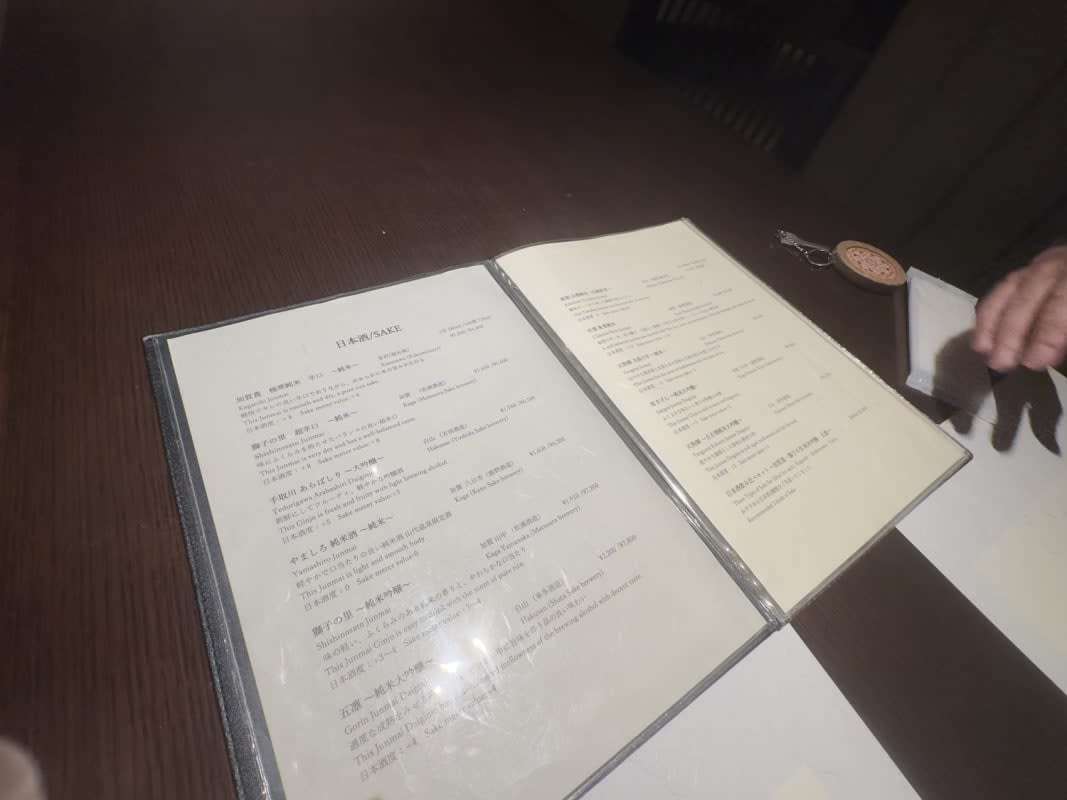
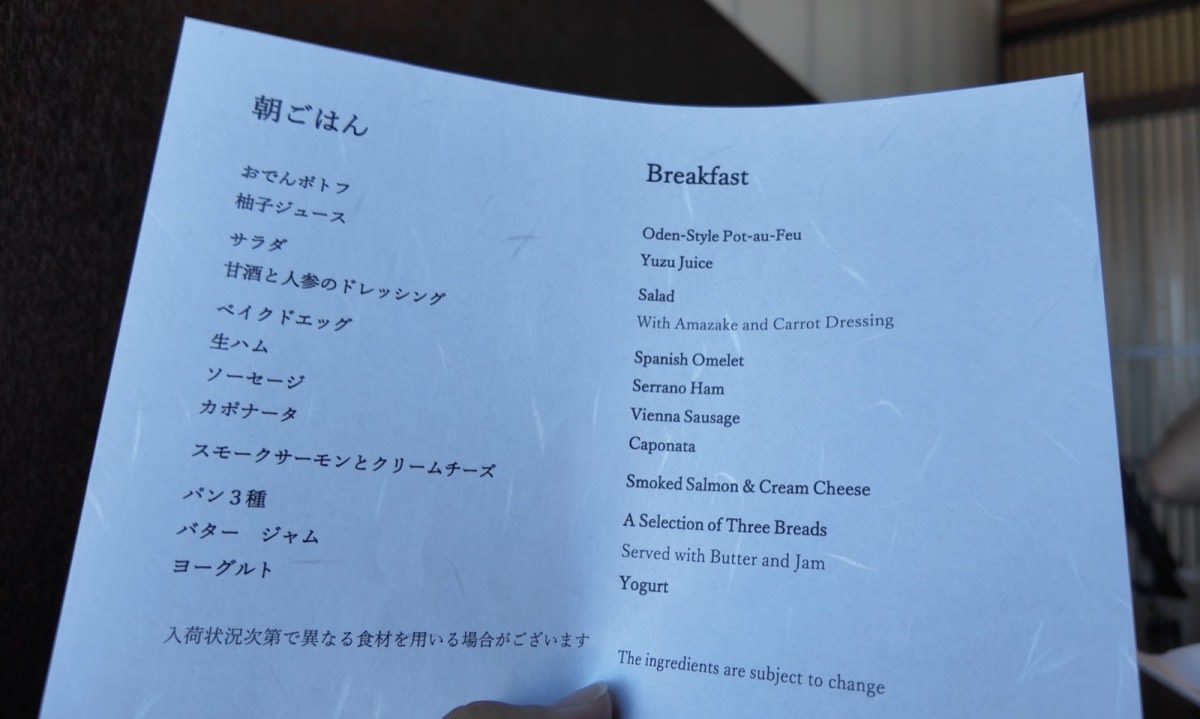
From November to March, the house switches to a menu given over entirely to crab, served as one and a half live animals, steamed, grilled and as sashimi; the premium version, called KIWAMI, serves a branded crab complete with its certificate of origin. The sake list is worth pausing on: it does not leave Ishikawa prefecture, from Hakusan’s Tedorigawa to Kanazawa’s Kagatobi, taking in two brews from Kaga itself, each with its rating and a tasting note in English. Breakfast, served from 7.15am to 9am, lays out a Japanese set built around a megisu fish soup. The Western option is nothing like an international hotel buffet: oden-style pot-au-feu, yuzu juice, salad with amazake and carrot dressing, Spanish omelette, serrano ham, caponata, smoked salmon and cream cheese, three breads, yoghurt. Vegetarian requests and children’s plates are booked in advance.
◆ In pictures · At the table
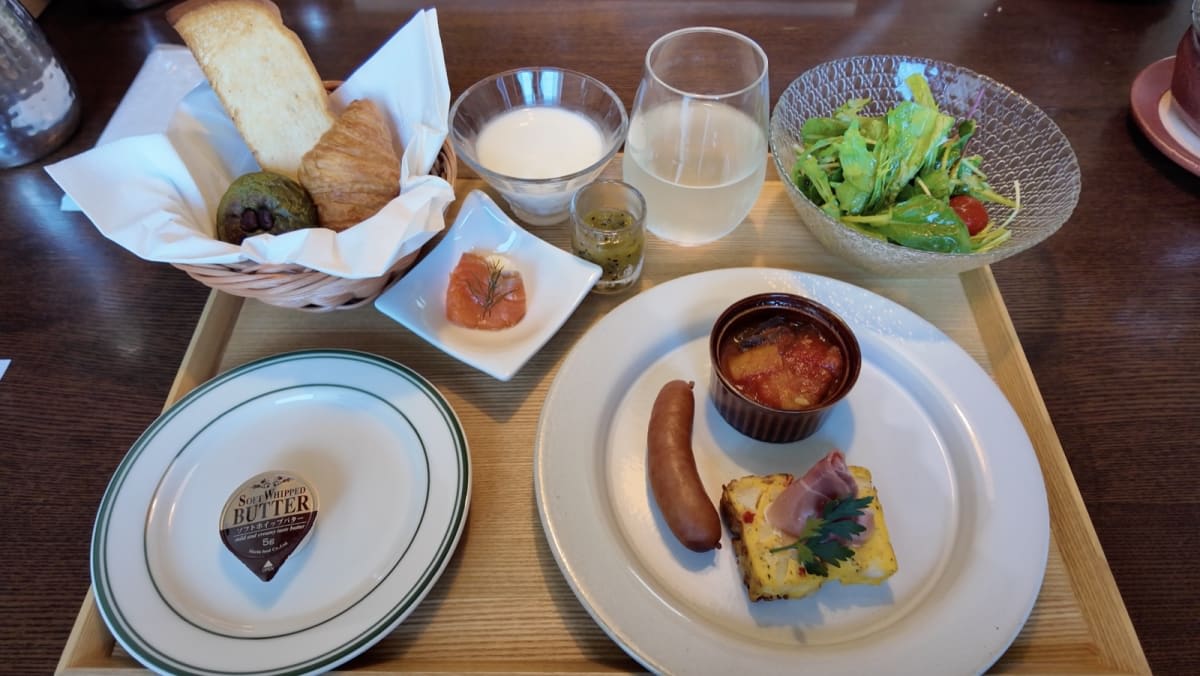
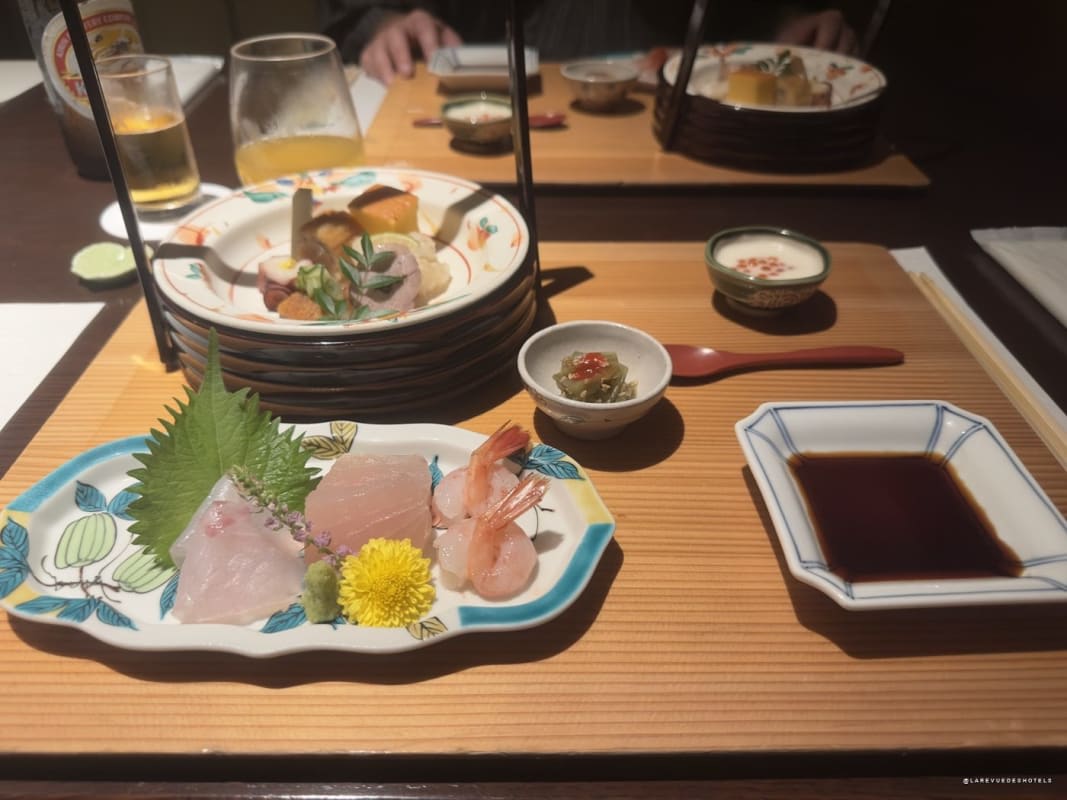
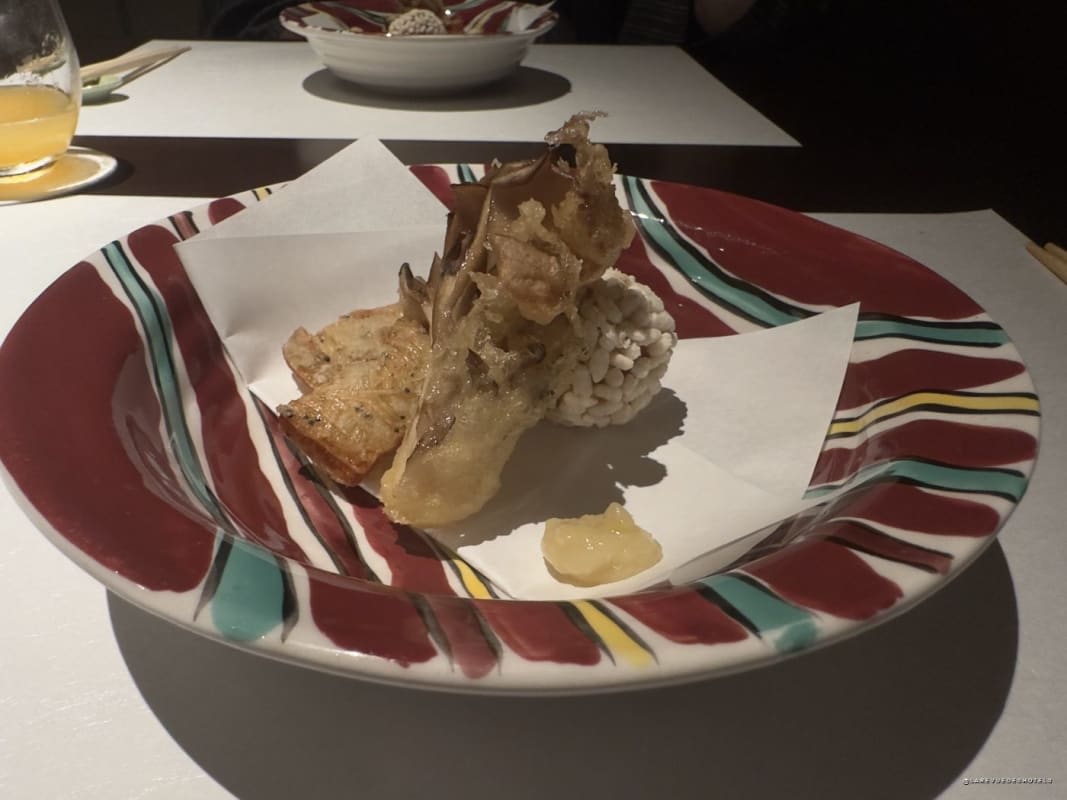
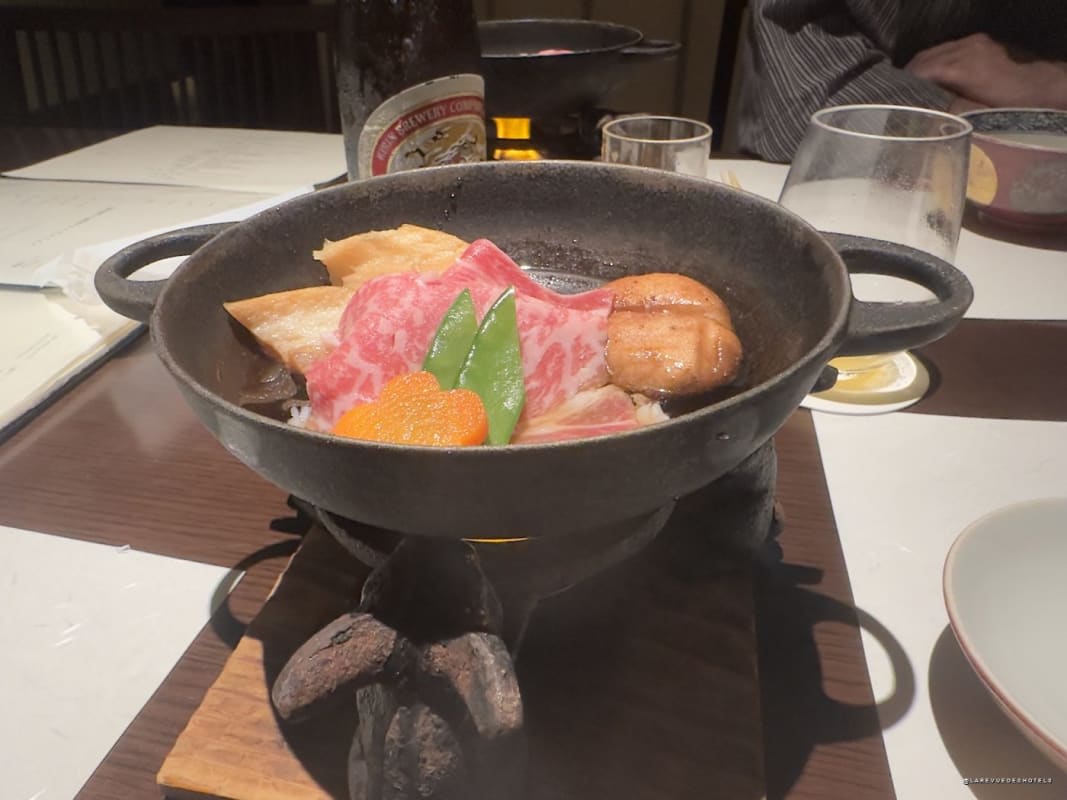
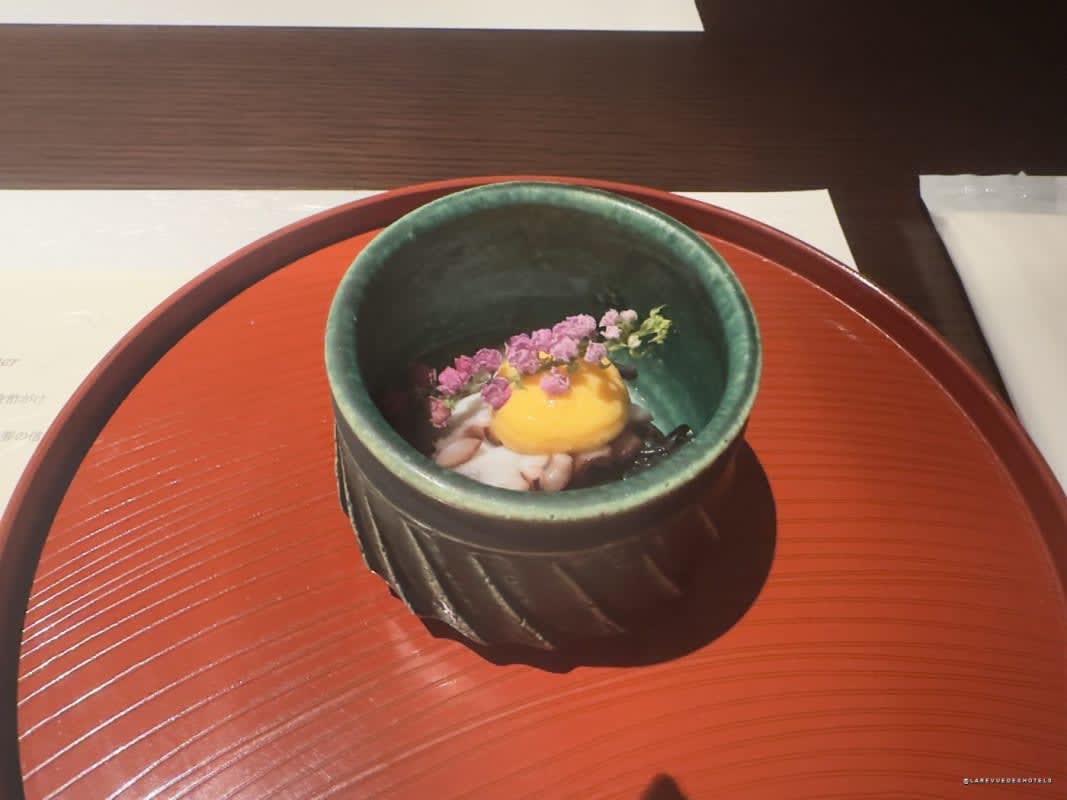
◂ Swipe · tap a photo to enlarge ▸
The hotel’s show: the lion dance
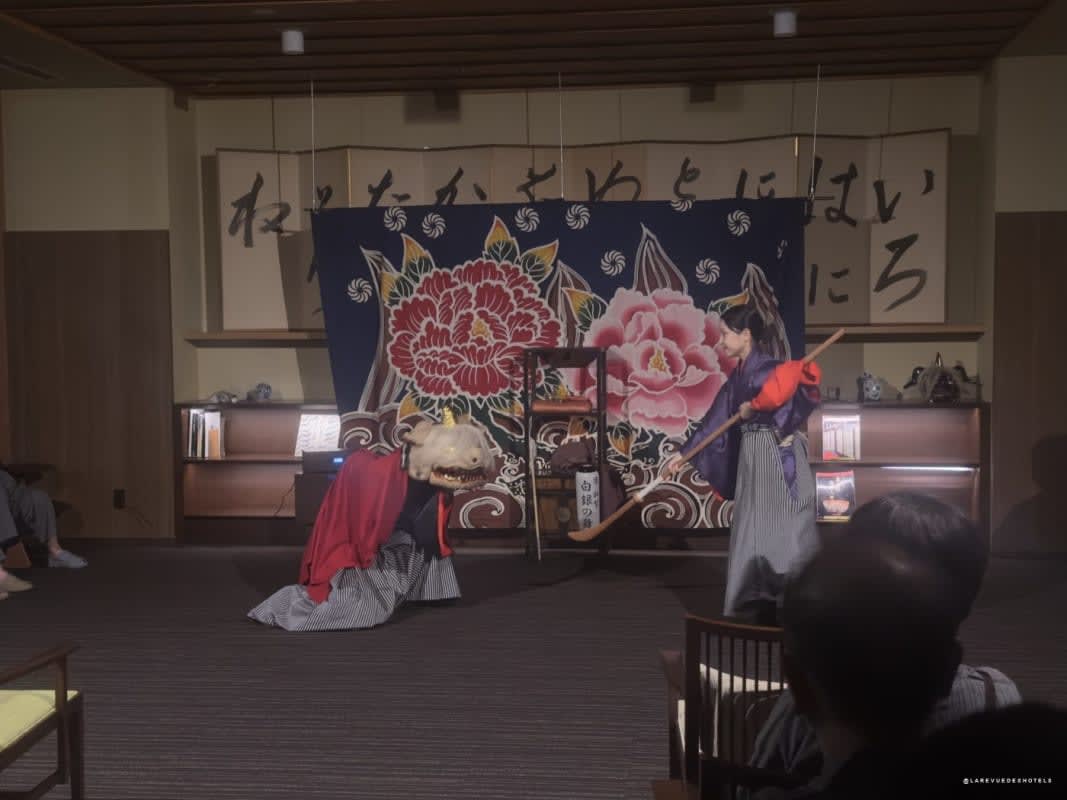
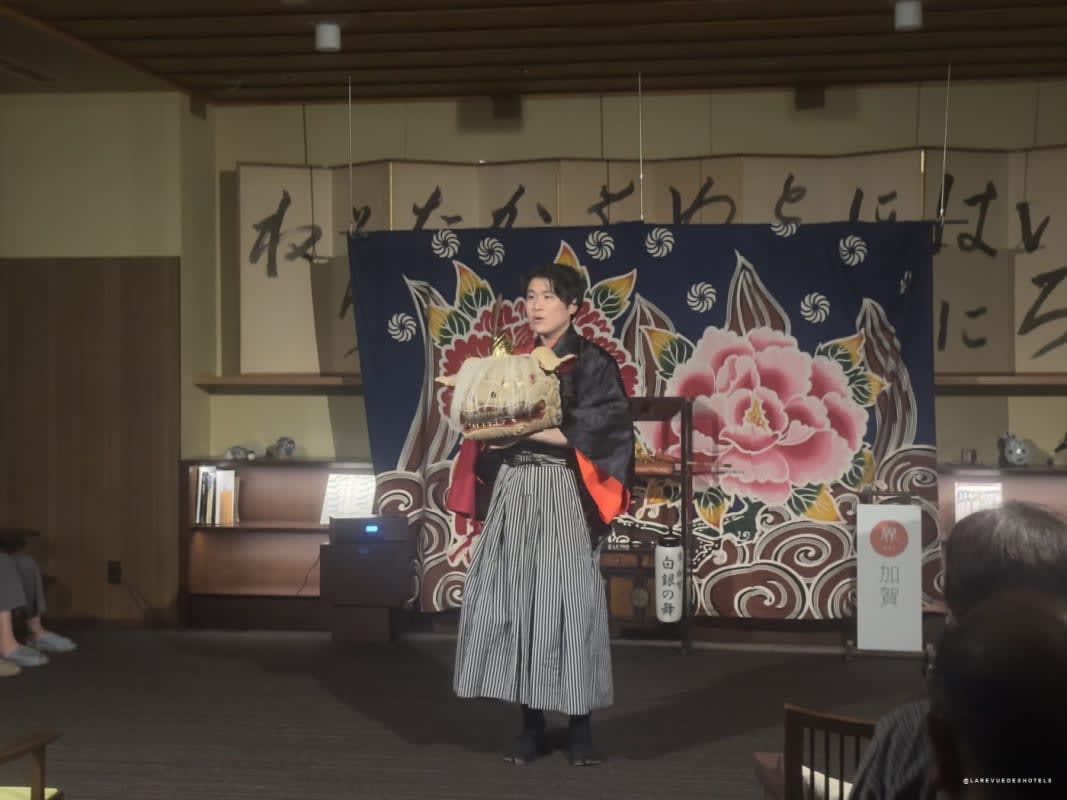
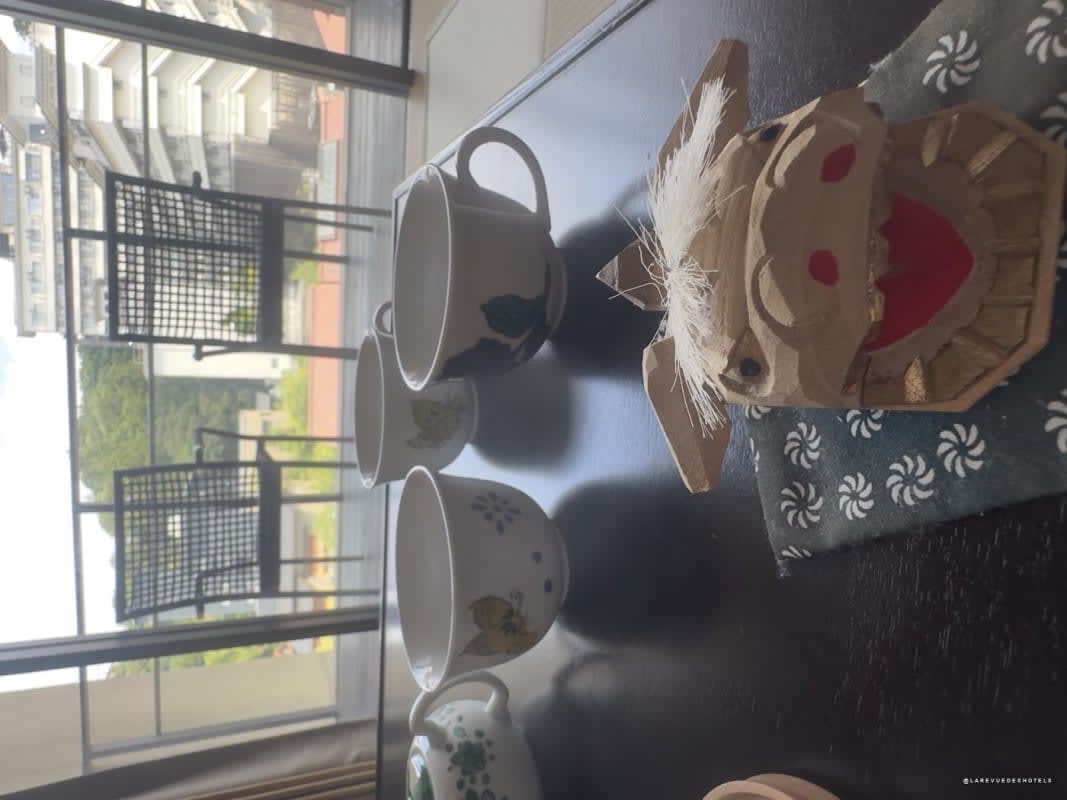
Every evening after dinner, the hotel’s common room turns into a stage. The property calls this event KAI Cultural Discovery: it is free, needs no booking and is open to all ages. KAI Kaga gives its version of the shishimai, the lion dance, a regional tradition whose first performances date back to the sixteenth century and which remains alive across Ishikawa prefecture.
The principle is that of a ritual combat: a warrior armed with a staff faces the shishi, a mythical lion whose white and gold wooden head snaps its jaws, while a second dancer animates the body under a red cloth. The choreography here is a contemporary reading, performed in front of a hanging painted with peonies and calligraphed screens. In local tradition, the beast drives out evil spirits before being appeased: the gesture is meant to bring luck to the house and to those staying in it.
The detail that changes everything: these are not guest performers but the hotel’s own teams, the same people who were serving dinner an hour earlier. The movement is crisp, the rhythm held, and the room, gathered around the stage, holds its breath. Hoshino resorts applies the same rule across all its KAI addresses: each property stages the craft or the living performance of its own territory, performed by its own staff.
◆ In pictures · The lion dance
◂ Swipe · tap a photo to enlarge ▸

The kintsugi workshop, a first in Japan
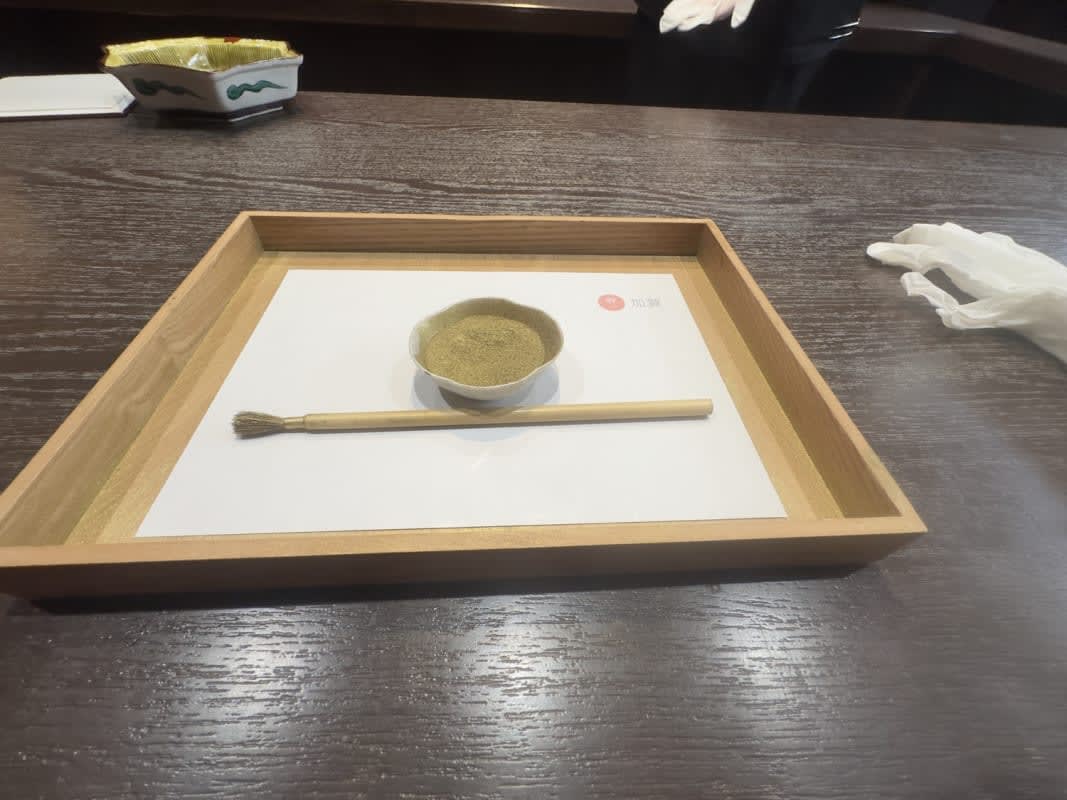
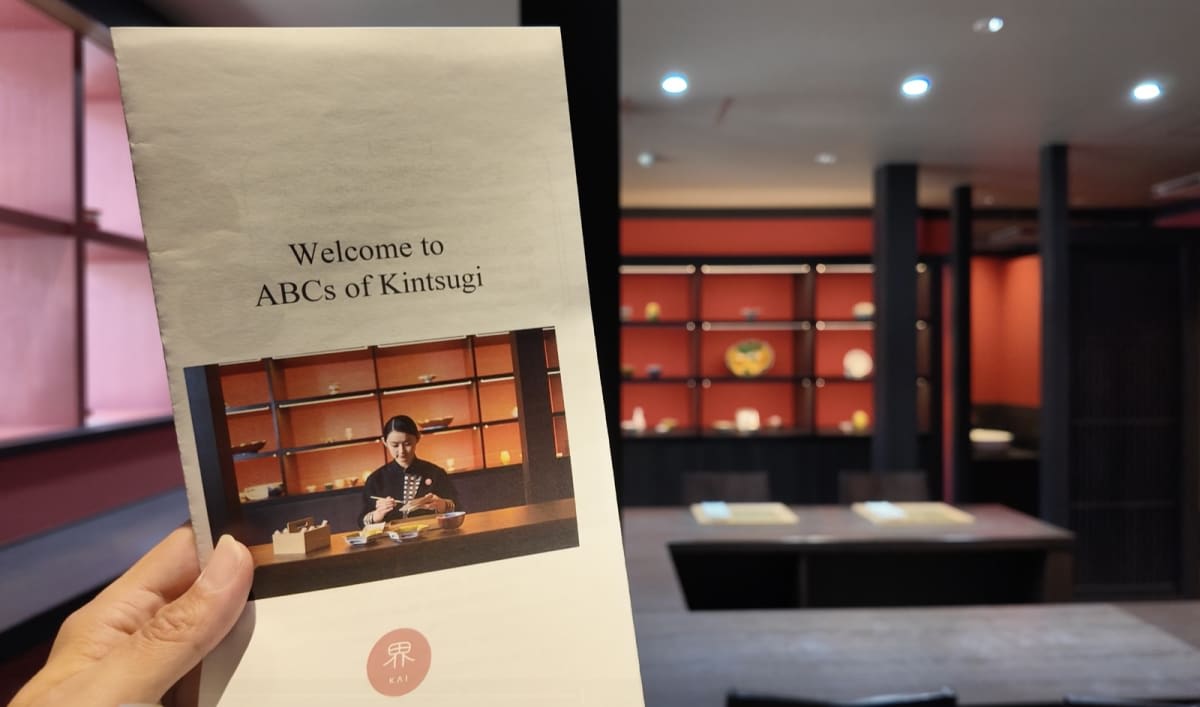
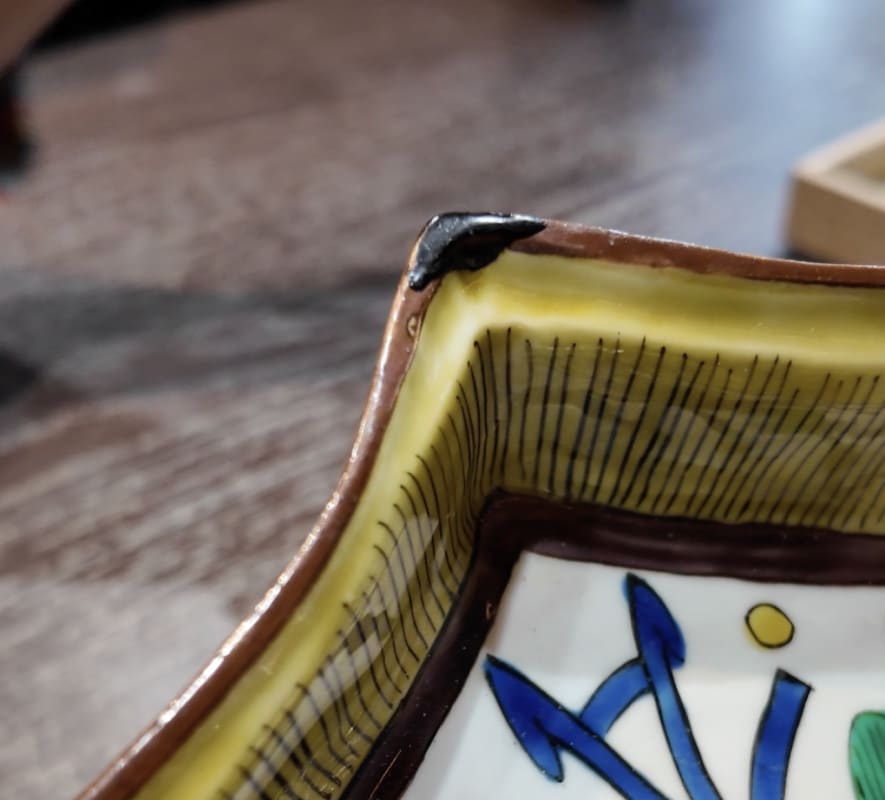
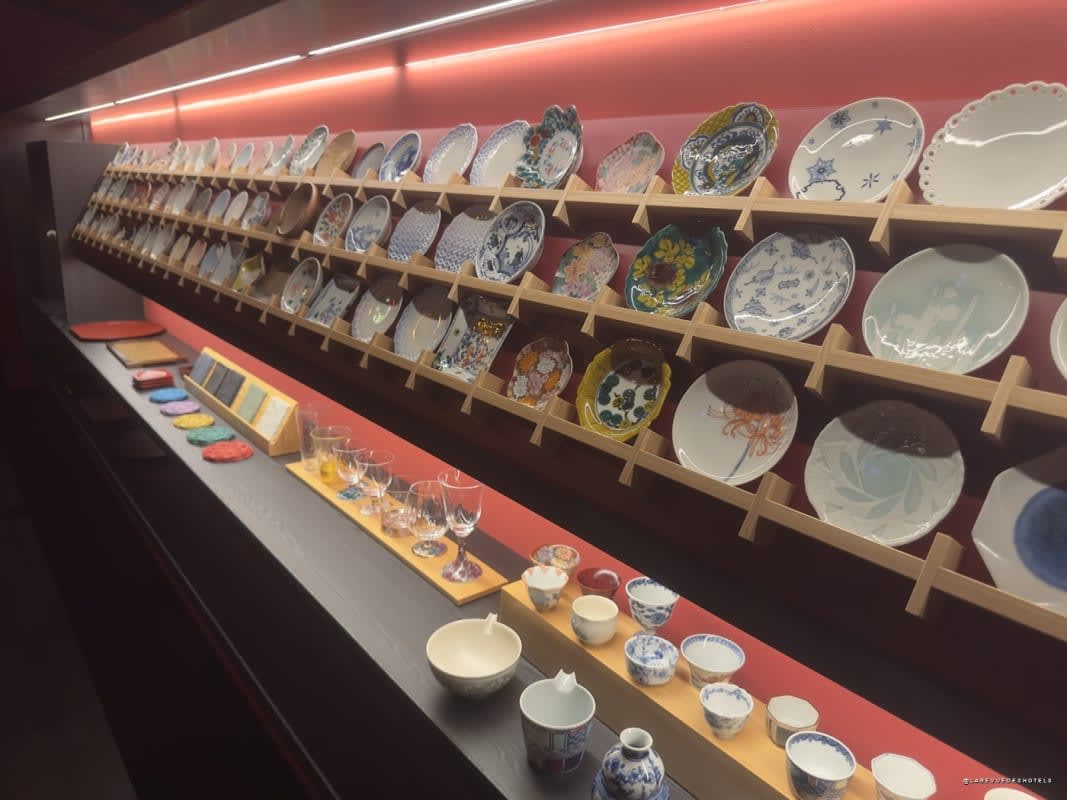
This is the strongest singularity of the address, and it is little known: KAI Kaga is the first hot spring ryokan in Japan to have set up its own kintsugi workshop, the art of repairing broken ceramics by highlighting the cracks in gold rather than hiding them. The workshop, which the house presents as “the first kintsugi workshop in a hot spring ryokan in Japan”, is called “ABCs of Kintsugi”. Opened to the public in April 2023, it had already welcomed more than 1,600 participants by spring 2024. The session is free for guests, on reservation, from age twelve.
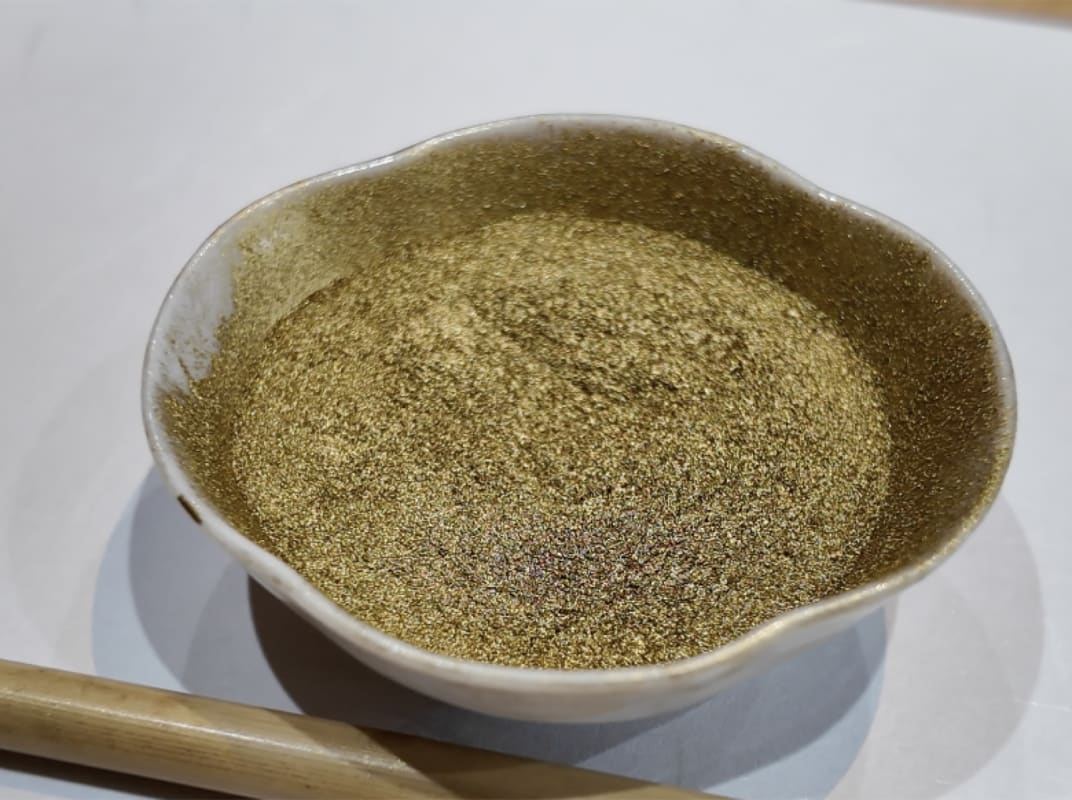
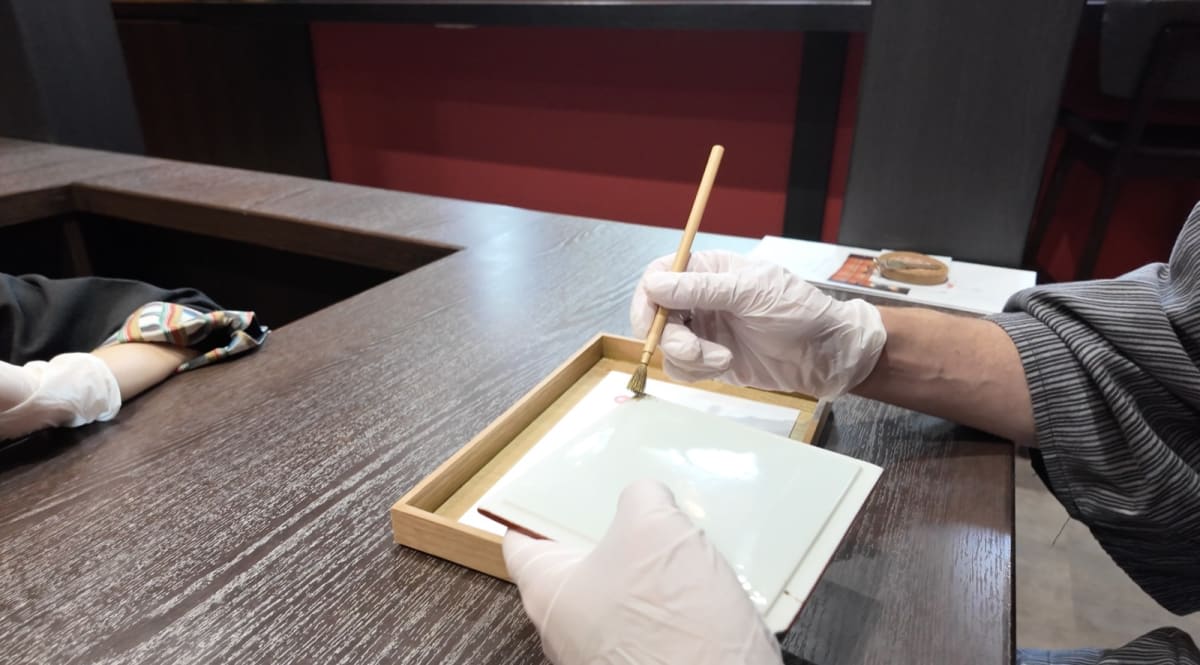
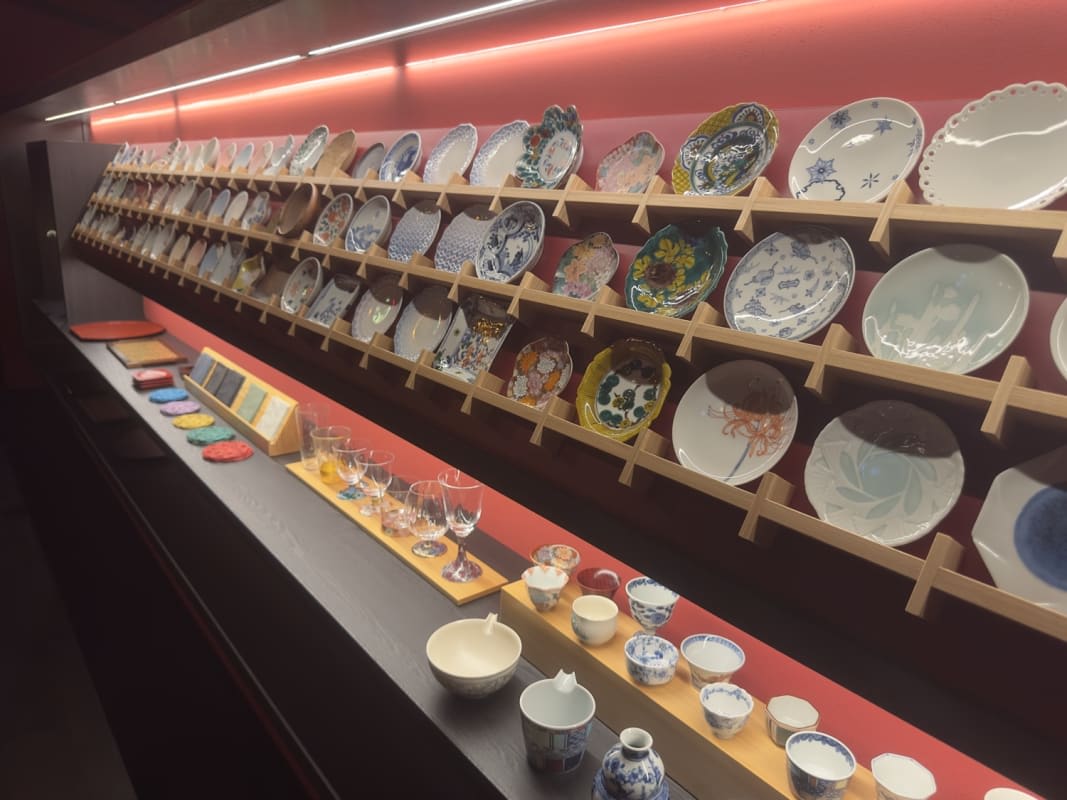
The workshop occupies a dedicated room, bengara red walls and shelves filled with ceramics, where each workstation is laid like a place setting. You repair a broken piece: the crack is first glued and filled, then, once the join is dry, you cover it with gold powder using a brush, gesture after gesture, until the break becomes a golden line. The movement is slow, meticulous, and you leave with your piece.
The point goes well beyond the manual work: in the philosophy that comes with it, the repaired object is worth more than the intact one, because it carries its history. A discourse that makes full sense in a region whose gold leaf and Kutani ceramics are the two great signatures. The restored pieces do not end up in a museum case: they are lined up on the workshop shelves, each carrying its golden scar.
◆ In pictures · The kintsugi workshop
◂ Swipe · tap a photo to enlarge ▸
The Bengara Lounge, where you choose your own cup
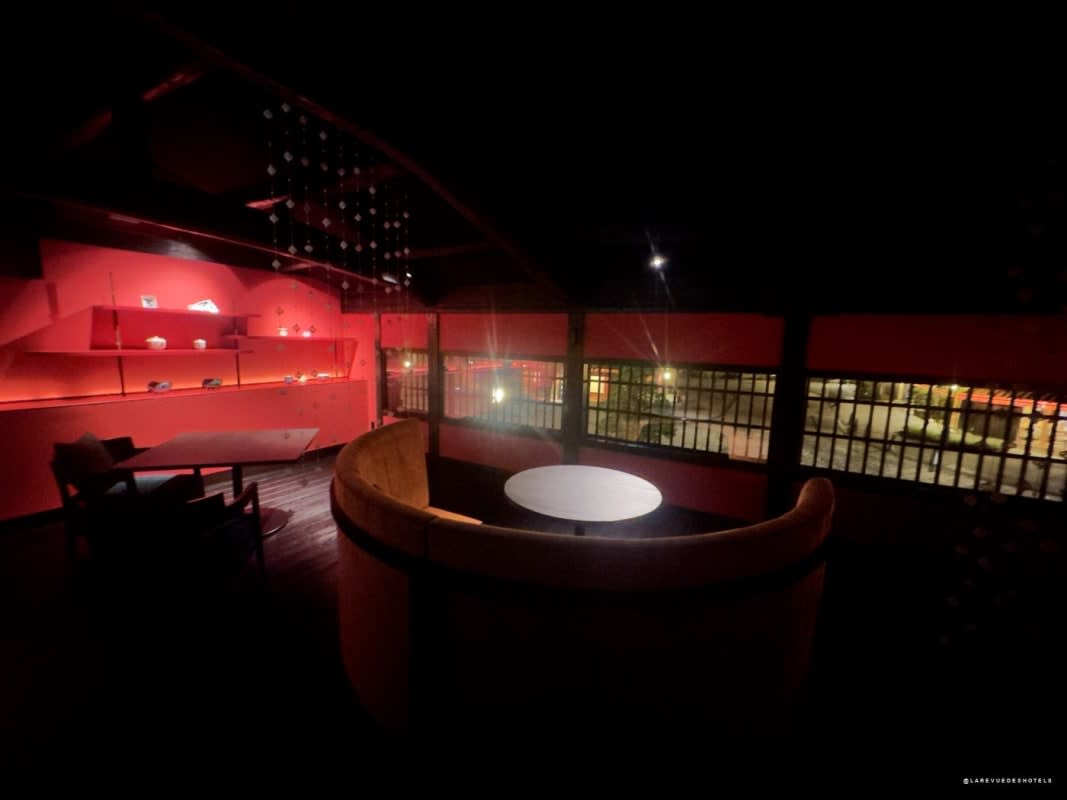
Installed since March 2024 in the hotel’s old wing, an Edo-period building, the Bengara Lounge (べんがらラウンジ) takes its name from bengara, the iron oxide red pigment used to paint the wooden lattices of the facade, the famous bengara-gōshi that marked out the Shiroganeya from the street. The bar therefore carries the colour of the building. The principle is as simple as it is enjoyable: you choose the vessel you will be served in yourself, from more than a hundred ceramic pieces lined up on the shelves.
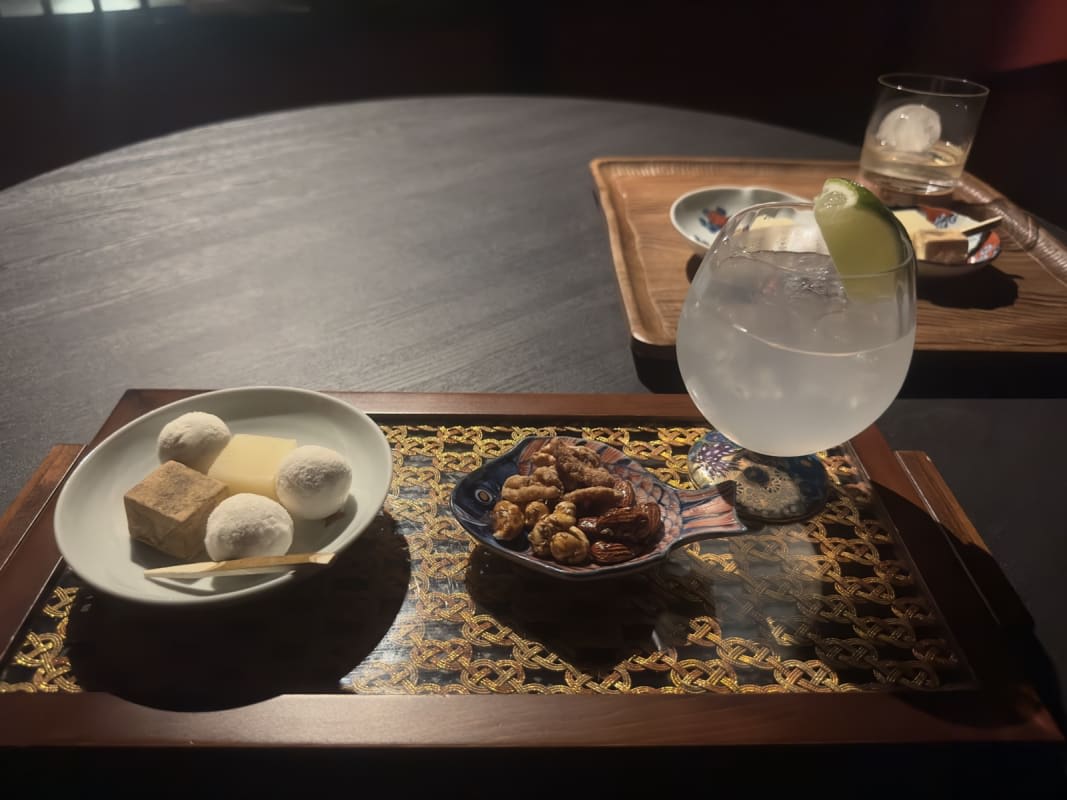
It is a late-evening appointment and nothing else: the room opens at 8pm and closes at 10.30pm, last orders at 10pm. The formula comes down to two choices, a drink from three sakes, a whisky, a shōchū, a gin or a plum liqueur, then a treat from pickles, nuts and confectionery, served with an assortment of three pintxos-style bites made with Hokuriku produce. Count 3,500 yen per person, further orders from 700 yen. The round banquettes turned towards the latticed windows look out over the hot spring town, thirteen centuries old. Two caveats to know: access is by reservation, and the salon is reserved for guests aged twenty and over.
Service comes on a tray, on a mat of golden mizuhiki knots, with the nuts presented in a fish-shaped Kutani dish: right down to a gin and tonic, the house puts its craft on show. On the sweet side, the house serves Noto milk gelati, from the neighbouring peninsula, in four flavours.
For families, the hotel has an alternative: a rest area facing the Ko-Sōyu, where drinks and treats are served on the way out of the bath, with no reservation or age condition.
◆ In pictures · The Bengara Lounge
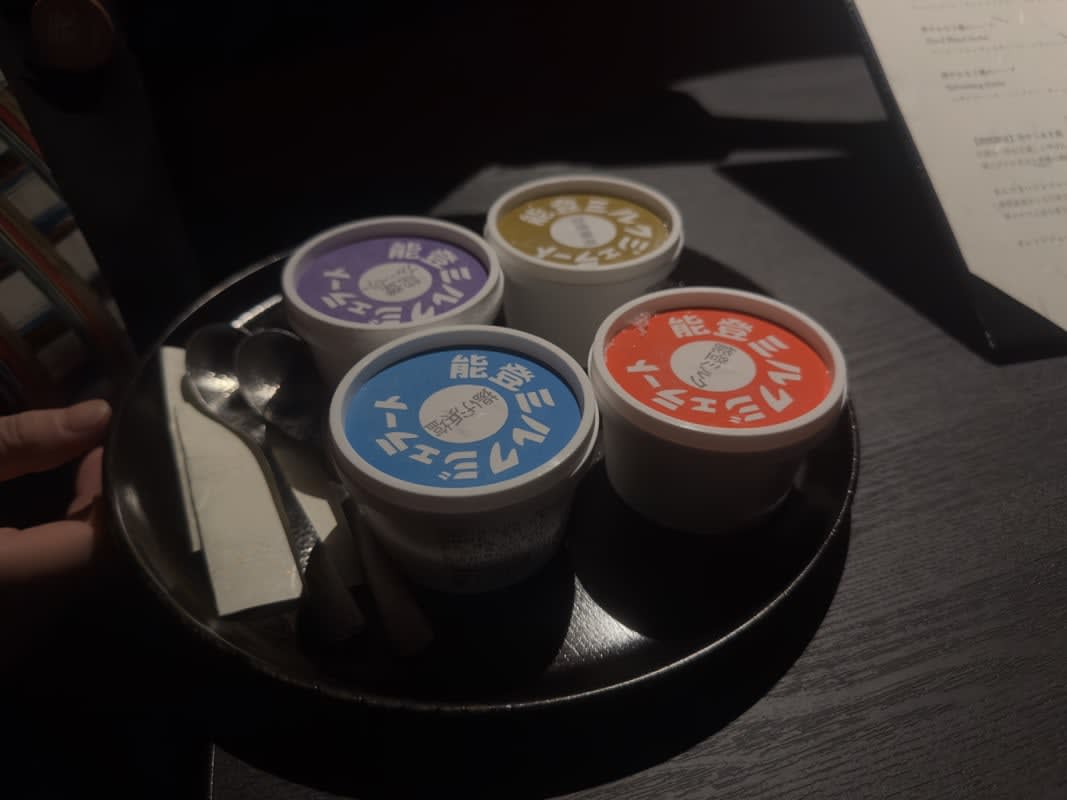
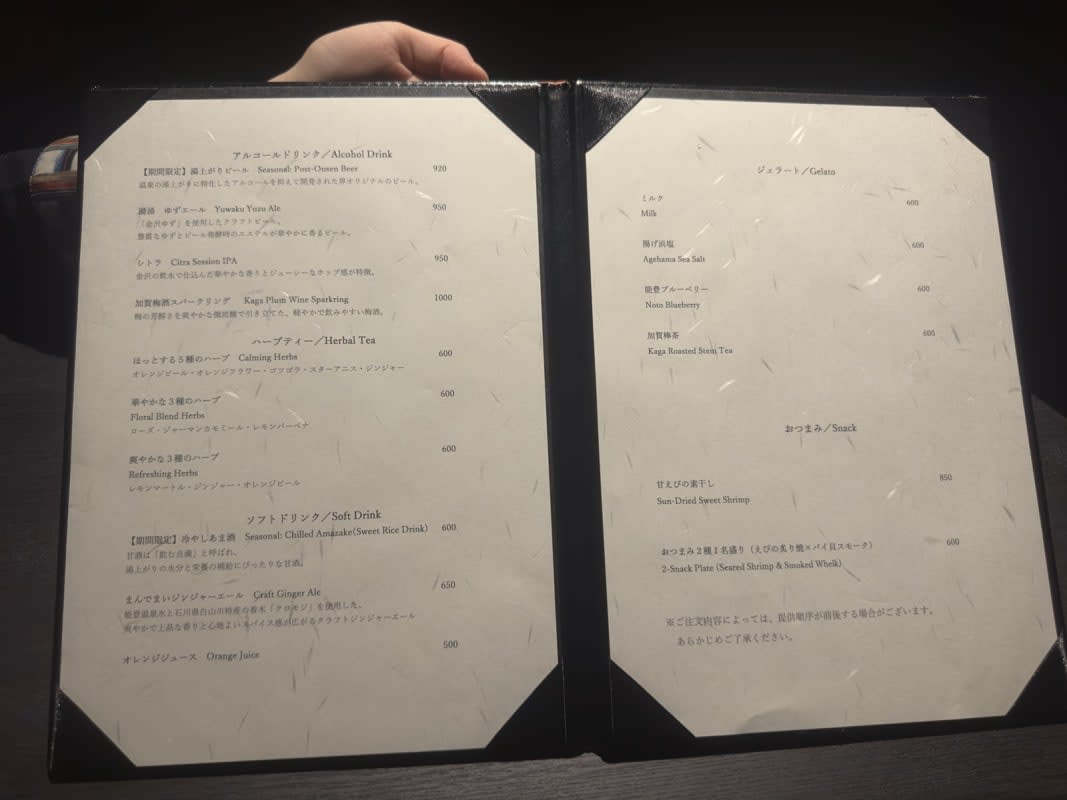
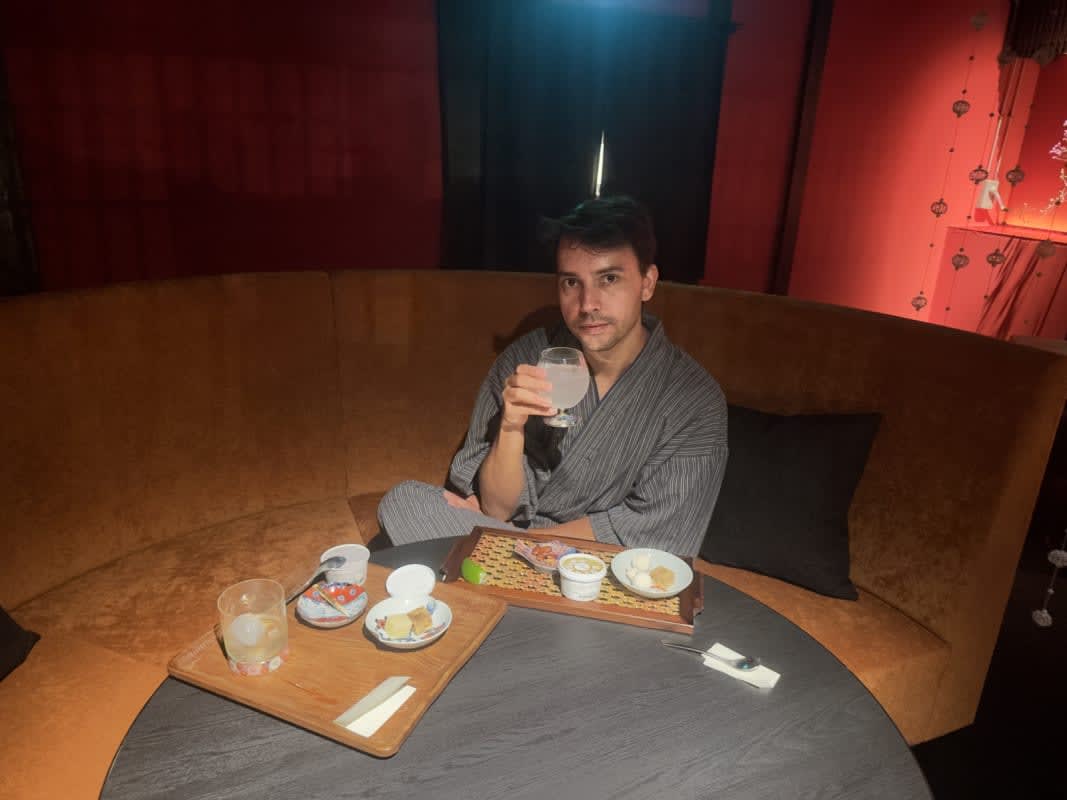
◂ Swipe · tap a photo to enlarge ▸
What the hotel adds, and what is included
The KAI brand makes a principle of keeping its cultural activities free, and KAI Kaga is no exception: the evening dance, the kintsugi workshop and entry to the Ko-Sōyu cost guests nothing. That last point deserves emphasis: the historic public bathhouse across the street is officially listed among the services included in the stay.
Added to that are seasonal events built around mizuhiki, the art of twisted paper knots of which Ishikawa is one of the birthplaces: wind chimes hung on the tea garden terrace in July and August, then coloured lanterns lighting the courtyard from September to November. In summer, cooling areas and refreshments accompany the exits from the bath. Finally, a massage service is offered on reservation, from age sixteen.
What to know before booking
Check-in is from 2.30pm and check-out at 11am, dinner at 5.30pm or 7.30pm and breakfast from 7.15am to 9am. Allow about ten minutes by car from Kagaonsen station, served by the Hokuriku Shinkansen from Tokyo, and roughly an hour from Kanazawa. As in the other Hoshino resorts KAI ryokans, the stay includes dinner and breakfast, a formula inseparable from the experience. One reservation, and only one: the ryokan format imposes its timings. With dinner at 5.30pm or 7.30pm and a show straight afterwards, the evening is written in advance, which leaves little room for anyone wanting to go out in the town.
Our verdict
KAI Kaga pulls off what many modernised ryokans miss: talking about craft without turning it into scenery. The ceramics, the lacquer, the gold leaf and the lion dance are not props arranged in a lobby: they are the objects you use, the tableware you eat from, the cup you repair yourself in the workshop, the show performed by the people who serve you. The Ko-Sōyu, two steps away, justifies the Yamashiro stop on its own. Our score: 9.7/10. Bookings are made on the official Hoshino resorts website.
- →OMO7 Osaka by Hoshino Resorts Hotel: Our Review After Testing
- →We tested OMO5 Kyoto Gion by Hoshino Resorts: our full review in the heart of the geisha district
- →Tourism in Japan: 42.7 million visitors in 2025, a record that reshuffles the deck
- →Onjuku Itsukiri: the Japanese resort where every room features a private sauna and onsen
Your turn: rate this hotel
Rate this hotel on the same criteria as our editors. One rating per reader · no personal data stored.