
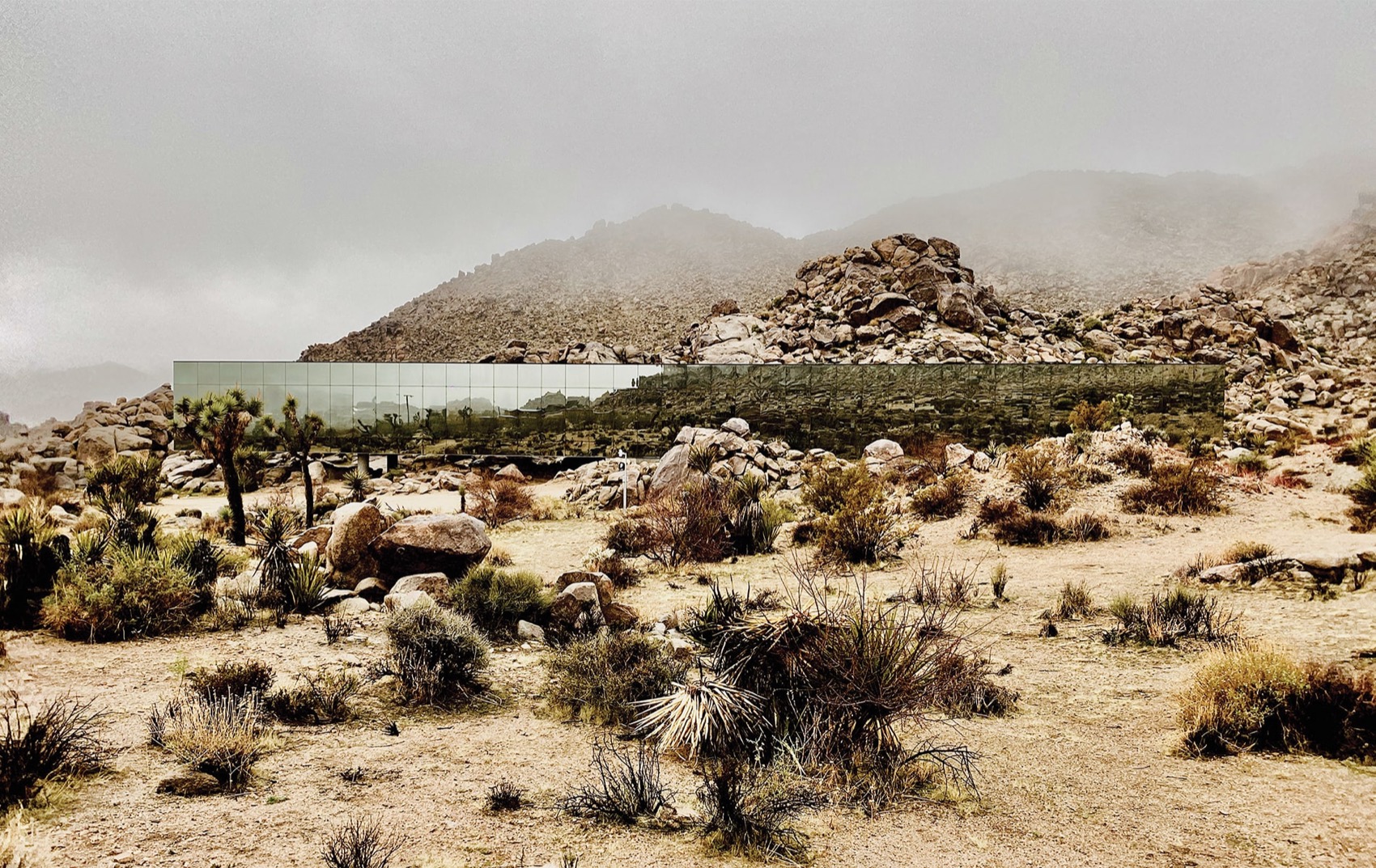

At first glance, there is nothing: sand, rocks, a few yuccas, and the steel-blue sky of the Mojave. Then the eye catches a reflection, a line too perfect, a rectangle of light sliding across the desert floor. The Invisible House does not reveal itself, it unveils its surroundings, transforming the visitor into a spectator of an endless panorama. It is precisely this architectural paradox that has propelled this Californian property to the status of a contemporary myth, at the crossroads of brutalist minimalism and total sensory experience.
Contents
A Skyscraper Lying in the Desert
The idea originated in the mind of Chris Hanley, the producer behind American Psycho and The Virgin Suicides, fourteen years before the house broke ground. He entrusted his vision to Tomas Osinski, a collaborator of Frank Gehry, with a clear intention: to erect a monolith that would not contradict the landscape but extend it. The reference is twofold: Mies van der Rohe’s Seagram Building in New York and the monolith from 2001: A Space Odyssey, two icons of geometry serving the absolute. The result is a 68-metre-long, 6.40-metre-high parallelepiped, elevated on cylindrical concrete caissons at one end, so that it appears to levitate above the rock formations.
The exterior is entirely composed of high-performance reflective glass ordinarily used on office towers. At dawn, the structure turns black. At noon, it merges with the sky and almost disappears. At dusk, it blazes in the desert’s orange hues before reflecting the first stars. Interior and exterior become one, ever-changing, never identical.
Five Hundred Square Metres Surrounding a Thirty-Metre Pool
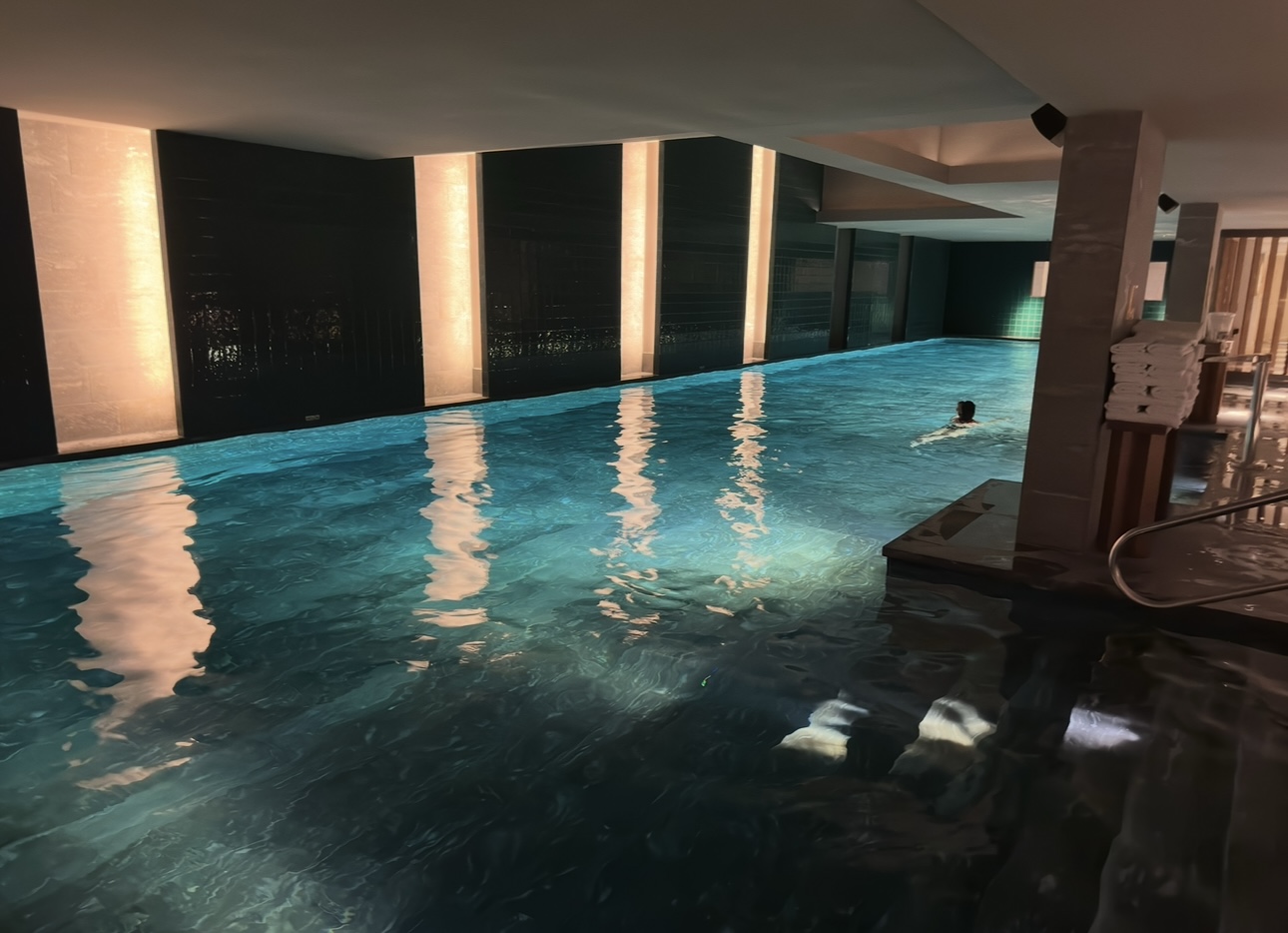
Inside, the design is utterly minimalistic. The polished concrete floor runs the entire length of the building, without unnecessary partitions, within a single living space that articulates three suites, four bathrooms, and a fully equipped kitchen. The heated indoor pool, over thirty metres long, forms the beating heart of the house, illuminated by large sliding glass doors that open to merge water and desert. The master bed is a unique piece, a solid glass slab suspended in transparency. Satellite service ensures connectivity; solar installations cover almost all consumption, boasting a near-zero carbon footprint. The property spans 90 acres, adjoining Joshua Tree National Park, making it the largest private plot directly bordering the park. There are hiking trails among the granite boulders and a peak accessible on foot from the house. A separate casita completes the ensemble and can accommodate two additional guests.
Hollywood’s Favourite Set
Since its inauguration, The Invisible House has quickly transcended the status of a private residence to become a cultural hub in its own right. Alicia Keys stayed there for several weeks to record an album. The Weeknd, Lizzo, Ariana Grande, and Demi Lovato, among others, have stayed there personally. The house has also featured on Netflix in several shows dedicated to the most spectacular holiday rentals, bolstering its global renown. Film crews regularly follow one another for music videos, advertising campaigns, and cinematic productions, representing a significant portion of the revenue generated by the property. In its first full year of rental, the house generated over a million dollars in revenue, confirming the market’s appetite for this type of unique architectural experience.
Booking: What You Need to Know
The Invisible House is available for rent on Airbnb and through specialist agencies. Rates start at approximately 2,200 to 2,500 dollars per night depending on the season and availability, with peaks exceeding 4,000 dollars for periods of high demand. The main house accommodates 6 people in its 3 suites; with the adjacent casita, the total capacity rises to 8 guests across 4 bedrooms and 5 bathrooms. The entrance to Joshua Tree National Park is less than two kilometres away. The property has also been put up for sale, whilst maintaining active rentals, a very rare opportunity for buyers wishing to acquire an already established rental asset.
The Invisible House embodies a proposition that far exceeds simple luxury accommodation: to stay here is to inhabit a living sculpture whose setting changes hour by hour, to immerse oneself in the radical silence of the Mojave Desert, and to share, for the duration of a stay, the mental space of a filmmaker who dreamt of a structure capable of disappearing into the landscape whilst dominating the horizon.