
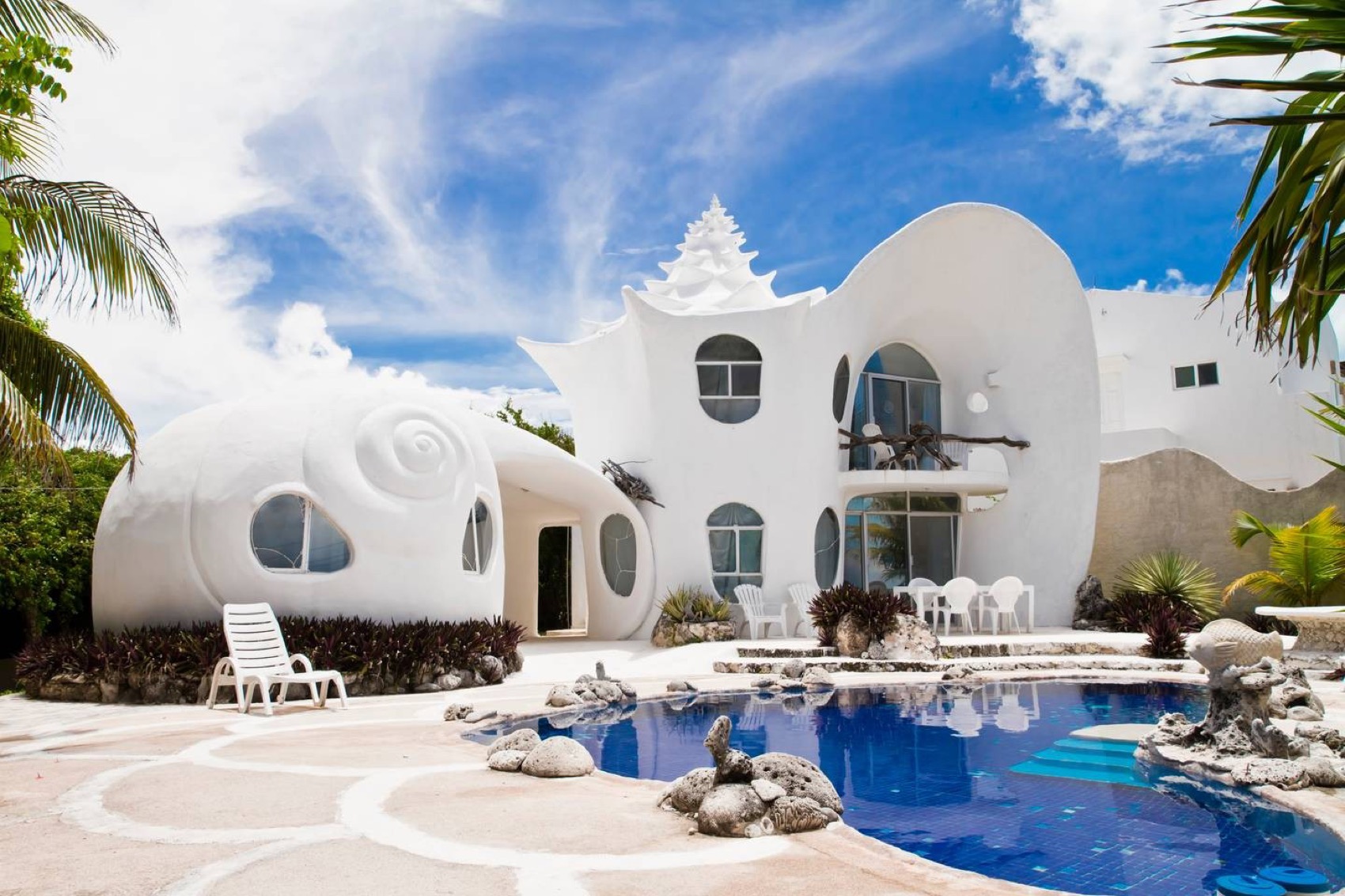

There are addresses one recognises at first glance, even without ever having seen them. Casa Caracol, on Isla Mujeres, is one of them: a spiral of white concrete that rises above the coconut palms, nestled in Punta Sur, at the southern tip of this small Mexican island bathed by the Caribbean Sea. Since the first photographs of this extraordinary house circulated on social media, the waiting lists have remained full. But behind the viral appeal, there is a story: that of a man, an architectural dream, and an island.
The Architect and the Seashell: A Vision Born on the Shore
It was in 1967 that Eduardo Ocampo first set foot on Isla Mujeres, arriving to participate in the construction of a hotel. The island captivated him. He returned, settled his life there with his wife Raquel in 1994, and it was there, on the plot of land he owned next to his own house, that the audacious project was born: to build a seashell. The genesis of Casa Caracol lies entirely in this intuition: the beaches of Isla Mujeres are covered with shells, so why not become one. Work began in 2001 and lasted three years, with Eduardo sometimes working alone when his vision exceeded what his collaborators could imagine. The initial objective was to create a studio and a holiday home for his brother Octavio, an internationally renowned Mexican painter, known for his trompe-l’œil portraits that reveal multiple images depending on the viewer’s perspective.
Organic Architecture: Inside a Marine World
Stepping through the door of Casa Caracol is to enter the logic of a seashell: no right angles, no vertical walls; everything curves, turns, and coils. The main structure unfolds over two levels around a spiral staircase. Downstairs, a sunken living room with a circular sofa, a dining room, and a kitchen. Upstairs, the master bedroom, a true showstopper: a king-size bed nestles under swirls of painted concrete, and a balcony opens onto the Caribbean Sea. The bathrooms take the metaphor to its fullest extent, with shell-shaped washbasins, coral-shaped taps, and showerheads that cascade water through marine spirals. On the walls, Octavio Ocampo’s canvases adorn every corner, their trompe-l’œil compositions dialoguing with the organic architecture as if the two brothers had always spoken the same language. The property has since expanded to three distinct structures: the original Casa Caracol, El Caracolito, and Shellito, two satellite units that adopt the same formal codes.
Staying in the Seashell: Practicalities and Rates
The property can accommodate up to six guests in its full configuration, with two main bedrooms and up to three bathrooms. The base rate for the main villa starts around 375 dollars per night, with additional units available from 70 to 100 extra dollars depending on the season. The entire property is managed directly by Raquel Ocampo, who lives next door and offers a personalised concierge service: golf cart rental (essential on an island seven kilometres long), private chef, massages, and grocery shopping. Seclusion is part of the journey: the house is far from the restaurants and shops of the town centre, which requires some planning but guarantees total tranquility. The freshwater pool, jacuzzi, and hammocks strung between the coconut palms create a serene haven facing the Caribbean. One or two iguanas have made their home in the garden, and their visits are now part of the experience, according to regulars.
The Island as a Backdrop: Isla Mujeres Beyond the Seashell
Located thirteen kilometres off the coast of Cancún, Isla Mujeres is reached by a twenty-minute ferry ride from Puerto Juárez. The island, barely seven kilometres long, lives at the pace of electric golf carts, fish markets, and beach shacks. Playa Norte, renowned for its powdery white sand and almost waveless turquoise waters, is considered by many travellers to be one of Mexico’s most beautiful beaches. Garrafón Park, at the southern tip, offers snorkeling over coral reefs. And for lovers of local flavours, the fish tacos and ceviches served in the restaurants on the main street serve as a reminder that the island is, first and foremost, a fishermen’s territory.

Casa Caracol is not a luxury hotel in the classical sense. It is something rarer: a habitable work of art, built by a man for his brother, on an island that once captivated him. The fact that it is now open to travellers from around the world is almost miraculous, and each stay feels less like a hotel night and more like an interlude in a marine fairytale.